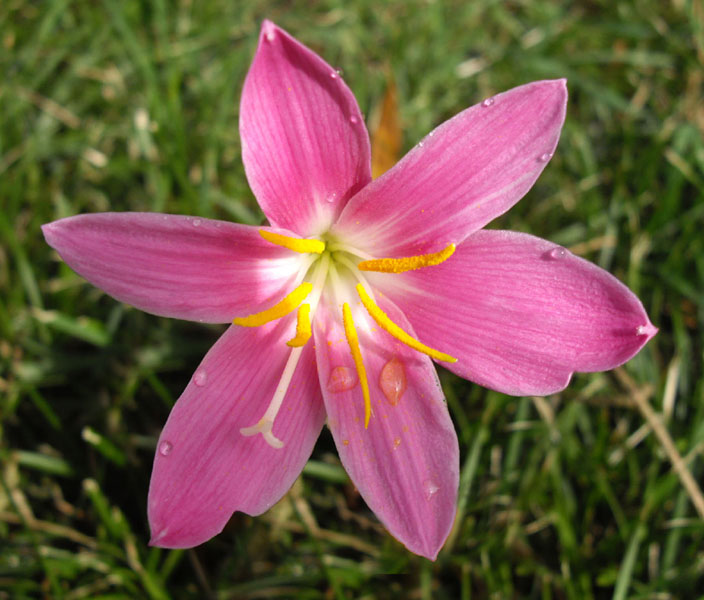
Bulbous perennial of the Amaryllidaceae family, this species is native to Mexico and Central America, where it grows in open meadows, grassy slopes, and edges, at various altitudes that can exceed 1,000 meters. It has been widely naturalized in many subtropical and Mediterranean regions of the world.
It forms small clumps of linear, upright, bright green leaves, reaching 20 to 30 cm in height, originating from a modest-sized tunicate bulb. The floral stems are solitary, hollow, each bearing a single, upright flower, bright pink to magenta-pink, 5 to 8 cm wide, with six spreading tepals and prominently visible golden-yellow stamens at the center.
A characteristic feature of the species is its reaction to summer rainfall: the flowers appear very quickly after a heavy rain, earning it the vernacular name "rain lily."
In its natural habitat, its flowering extends from summer to autumn. In cultivation under a warm temperate climate, it blooms mainly from July to October, often in successive waves triggered by watering.
It requires well-drained soil, a sunny exposure, and some summer warmth. In cold climates, the bulbs must be brought indoors to protect from frost. It is suitable for containers, borders, and rock gardens in regions with mild winters.