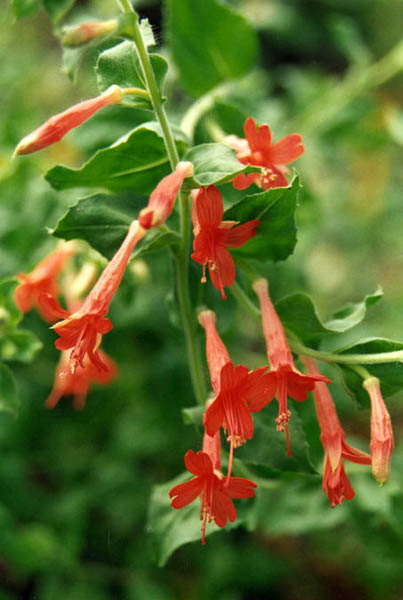
syn. Zauschneria garretii
syn. Zauschneria garretii
A suffrutescent perennial of the Onagraceae family, this subspecies is distinctly different from the canum subspecies by its bright green foliage, not silvery, with wider, oval to slightly toothed leaves, giving it a much more herbaceous appearance. It is native to the mountainous regions of Utah and neighboring states of the Great Basin, where it grows in rocky slopes and dry to semi-arid shrub edges.
It forms a flexible and branched bush of 40 to 60 cm, with slender stems bearing leaves of a medium to bright green, giving it a fresher and less xerophytic character than the Californian subspecies. The tubular flowers, in a warm orange-red tending towards vermilion, are borne in loose, drooping clusters at the ends of the branches, with slightly flared and well-individualized petals at the opening, giving them a more open and graceful appearance than ssp. canum.
In its natural habitat, its flowering extends from July to September. In cultivation, it occurs similarly, from August to October.
It tolerates slightly cooler conditions and a somewhat richer soil than the canum subspecies, while requiring the same rigorous drainage. Its green foliage, not protected by a silvery tomentosity, visibly suffers under too intense and too dry sun; an exposure in partial shade or light afternoon shade suits it better. It thus integrates more into semi-shaded rock gardens than into scorching embankments and is more hardy than ssp. canum in climates with cold winters.