An annual of the Asteraceae family, this species is native to the Mediterranean region and Western Asia, from the Iberian Peninsula to the Caucasus and Iran. It colonizes dry grasslands, open garrigues, rocky slopes, cultivated fields, and fallow lands on poor soils, generally at low and medium altitudes.
It forms erect, slender, and branched stems, covered with a whitish tomentum, reaching 20 to 50 cm in height. The leaves, lanceolate and narrow, are also cottony, giving the whole plant a characteristic grayish appearance.
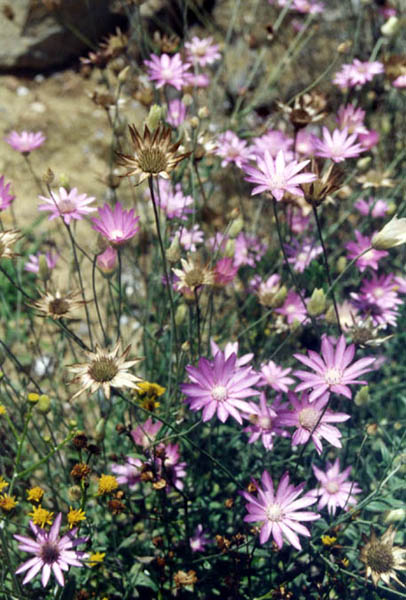
The flower heads, borne individually at the top of the stems, have scarious, pink-lilac to pink-violet involucral bracts, narrow and acute, which open little at anthesis — a distinctive feature that gives the species its epithet inapertum, meaning "not open." The central tubular flowers are tiny and discreet. The dry flower heads persist long on the plant and retain their color, making them appreciated for dry bouquets.
In its natural habitat, its flowering extends from June to August. In cultivation, it blooms from June to September depending on conditions.
It is sown directly in place in spring, in any well-drained soil, poor to moderately fertile, in full sun. Hardy and undemanding, it tolerates summer drought and is suitable for Mediterranean gardens or naturalized sowing on dry soils.