Annual or short-lived perennial, Viola tricolor is widely distributed in Europe and temperate Asia, from plains to subalpine levels, where it grows in poor meadows, grazed lawns, crops, and disturbed grounds. Mountain populations, more compact and more vividly colored than those of the plains, often correspond to the subspecies subsp. alpestris or to high-altitude forms not formally distinguished.
It forms small low and branched tufts, reaching 5 to 15 cm depending on conditions, often more compact at altitude. The leaves are oval to lanceolate, crenate, accompanied by well-developed and deeply cut stipules, a distinctive feature of the genus.
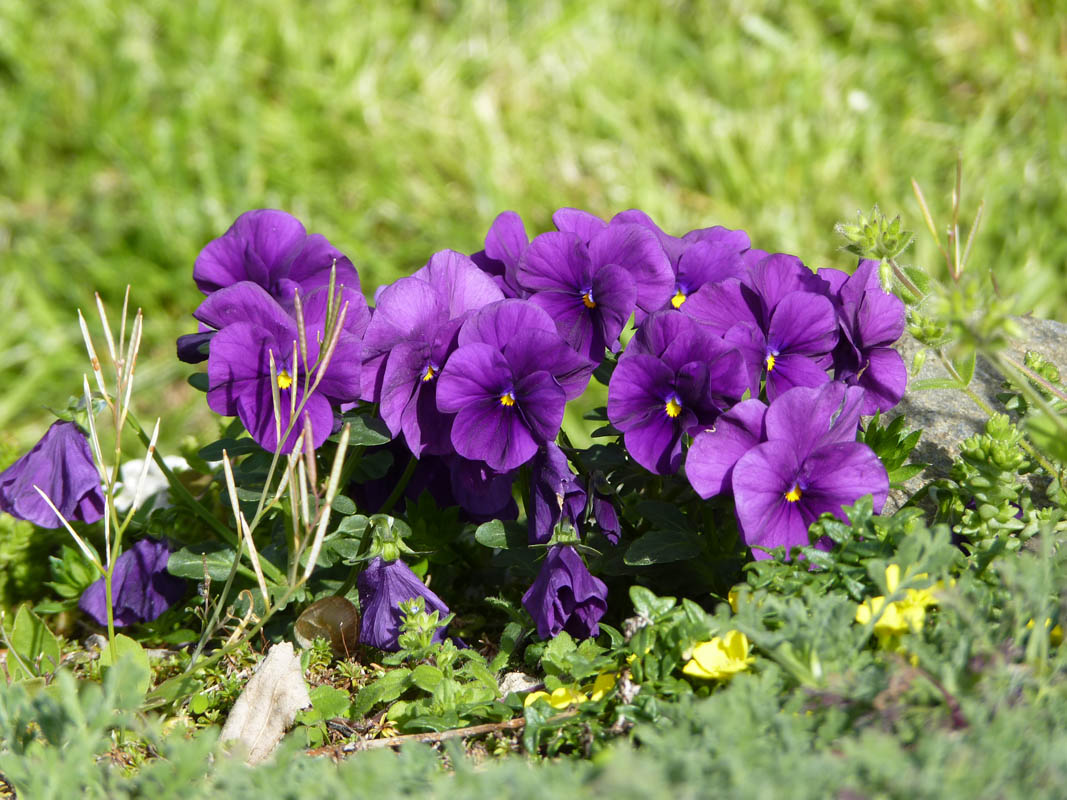
The flowers, borne on slender peduncles, classically combine violet, yellow, and white — hence the name tricolor — but alpine populations frequently display entirely intense violet flowers, as shown in the photograph, with a small yellow eye at the center. In its natural habitat, its blooming extends from May to September depending on altitude.
Formerly used in popular herbal medicine, notably for skin conditions, it is the wild ancestor of garden pansies resulting from 19th-century horticultural crosses. In cultivation, it self-seeds spontaneously and requires little care, on well-drained soil and in full light.