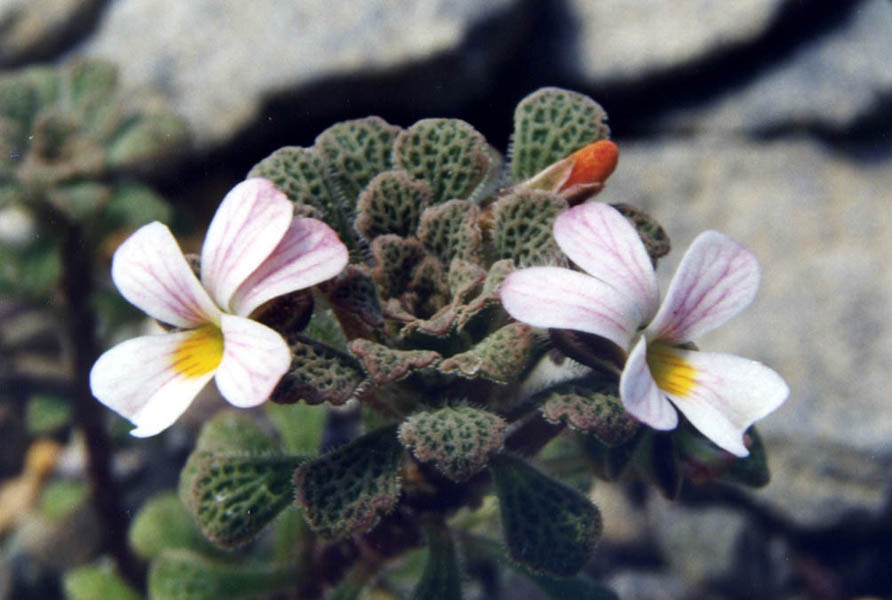
Violaceae. Endemic to Chile, this small perennial with creeping and branched stems grows in the Andes mountain range, in the regions of Santiago, O'Higgins, and Maule, on dry, well-drained mineral substrates, exposed to intense light and a marked alternation between a cold snowy season and a dry, hot summer. It belongs to a little-known group of rosulate Andean violets, whose habit and foliage radically differ from the usual image of the genus.
The plant forms small, dense, and naturally branched rosettes, not exceeding 1 to 2 cm in height, pressed against the ground. The leaves are spatulate, strongly reticulated and wrinkled on their upper surface, ciliated on the margins, and present in their living state a characteristic reddish-brown hue, presumably linked to the strong ultraviolet irradiation at altitude, making them almost indistinguishable from the surrounding rocky substrate. The sepals are hirsute. The flowers, large relative to the size of the plant, have unequal petals, pink to lilac. The variety arbuscula, described by Reiche in 1896, is distinguished by more erect stems and white petals with a purple center.
In its natural habitat, its flowering extends from December to January, in the height of the austral summer after the snow melts.
Like most rosulate Andean violets, it is reputed to be difficult to cultivate, but this species can be treated as a short-cycle annual. An autumn sowing in an alpine greenhouse, on a well-drained and sufficiently moist mineral substrate, allows for flowering at the end of winter or early spring, with the alpine greenhouse providing the necessary light, protection from winter rains, and the cold it needs.