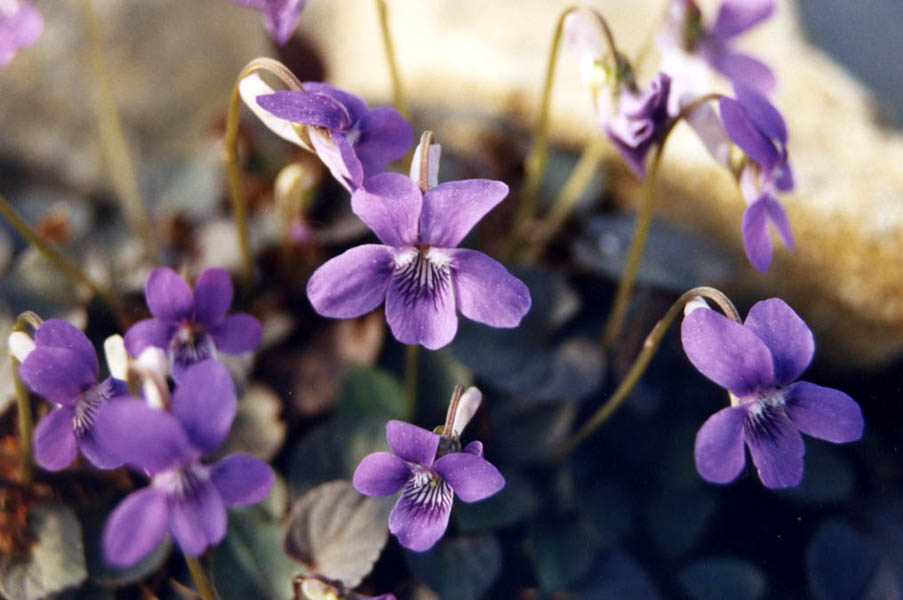
Perennial of the Violaceae family, Viola labradorica is native to the northeast of North America, from Labrador and Greenland to the Appalachians, where it grows in clear undergrowth, moist edges, and shaded rocky areas.
It forms small low and spreading clumps, barely exceeding 5 to 10 cm in height, which propagate freely by spontaneous seeding to gradually form a light and natural ground cover.
The foliage is one of its most unique assets: the reniform to cordiform leaves, finely crenellated, display in spring a dark green hue distinctly washed with bronze-purple, particularly intense at emergence. This coloration fades in summer without disappearing completely, giving the foliar carpet a lasting decorative character. The flowers, borne on slender peduncles, are a bright violet-lilac, with well-marked dark veins on the lower petals.
In its natural habitat, its flowering extends from May to June. In cultivation, it blooms at similar dates, sometimes with a slight autumnal resurgence.
It thrives in fresh, humus-rich, and well-drained soil, in shade or partial shade. Hardy and undemanding, it readily reseeds itself and can colonize the gaps in paving or the edges of a shaded wall. Its tendency to spontaneous seeding should be monitored in small spaces.