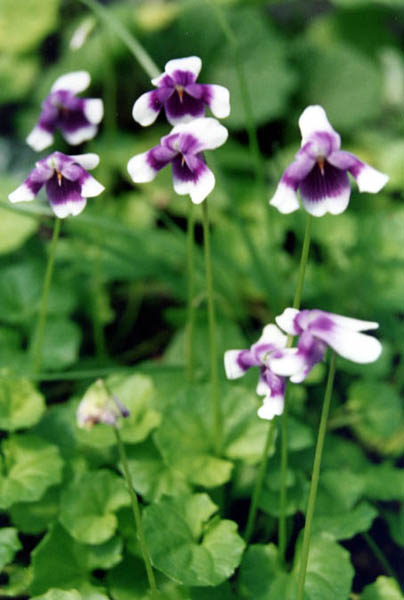
A perennial of the Violaceae family, Viola hederacea is native to southeastern Australia and Tasmania, where it colonizes humid undergrowth, shaded banks, and fresh meadows at low and medium altitudes.
It forms a creeping and dense carpet, barely exceeding 5 to 10 cm in height, spreading by stolons to gradually cover the ground. The leaves are kidney-shaped to orbicular, slightly crenate, of a bright and shiny green, indeed reminiscent of ivy leaves — hence its Latin epithet.
The flowers, borne on slender erect peduncles, display a very characteristic bicoloration: the lower and lateral petals are pure white, while the upper petals show a deep purple-violet, with dark veins clearly visible at the center. This inverted color distribution, white at the bottom and violet at the top, is an immediately distinctive feature within the genus.
In its natural habitat, its flowering extends from September to January. In cultivation under our latitudes, it generally blooms from spring until the first frosts.
It requires a fresh, humus-rich, well-drained but never dried out soil, in shade or partial shade. Not very hardy, it should be brought indoors in winter in cold regions. It is perfectly suited for cultivation in pots, bowls, or as ground cover in mild gardens.