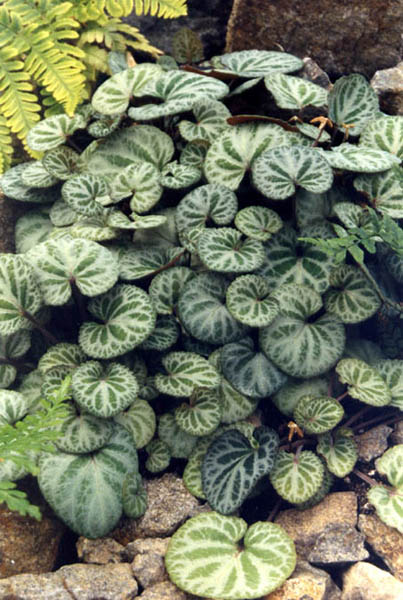
syn. Viola coreana
syn. Viola coreana
Perennial of the Violaceae family, native to Japan and Korea, where it grows in cool undergrowth, shaded edges, and wooded mountain slopes.
It forms a dense and spreading carpet, 10 to 15 cm in height, with regular progression by stolons. It is above all a plant with remarkable foliage: the heart-shaped, rounded leaves are marked with a contrasting silvery network on a dark green background, with veins drawing a radiating pattern of great clarity. This persistent foliar ornamentation throughout the season makes it an exceptional ground cover for shaded areas.
The flowers are small, violet to pale lilac, discreet among the foliage. As with other violets without a marked aerial stem, the plant also produces cleistogamous flowers ensuring abundant fruiting and spontaneous dissemination in favorable conditions.
In its natural habitat, flowering extends from March to May. In cultivation, it generally occurs in April.
It requires cool, humus-rich, well-drained soil, in shade or partial shade. It naturalizes easily under trees and shrubs, and willingly associates with ferns with fine foliage, as shown in these images.