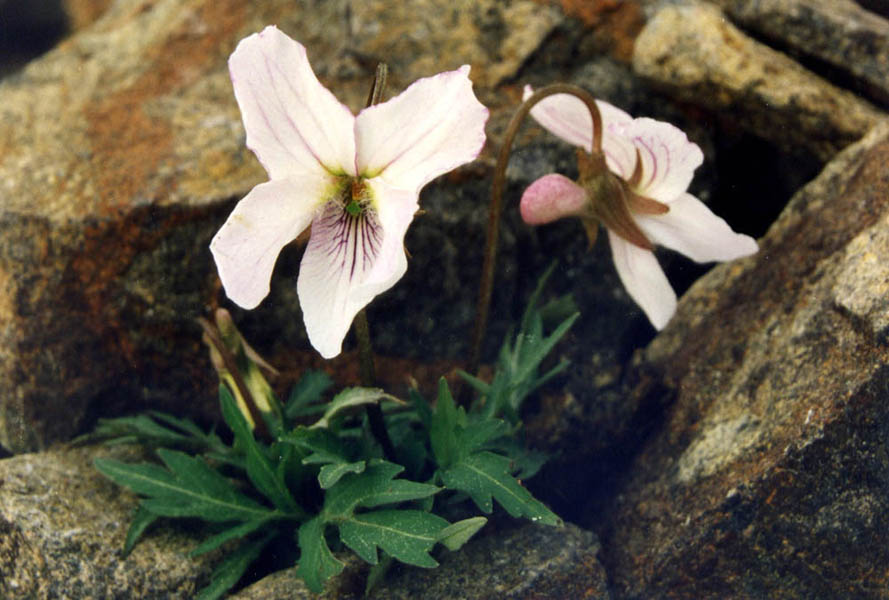
Perennial of the Violaceae family, native to Japan and Korea, where it grows in rocky areas, grassy slopes, and edges of mountain forests. Its taxonomy is complex and the boundaries between the varieties of Viola dissecta are debated according to the consulted floras.
It forms a small, low, and compact tuft, 8 to 15 cm in height when in bloom. The foliage is one of its most remarkable features: the leaves are deeply cut, with toothed and irregular lobes, a glossy dark green, giving the plant a very different appearance from most violets cultivated in Europe.
The flowers, large relative to the size of the plant, are a very pale pinkish white, almost pure white, with fine purple-violet veins well-marked on the lower and lateral petals, converging towards the greenish throat. The flower buds have a more pronounced pink hue, contrasting with the open flowers. The petals are broad and slightly wavy, giving the flower an airy appearance.
In its natural habitat, its flowering extends from April to June. In cultivation, it generally blooms in April-May.
It requires well-drained soil, cool without excess winter moisture, in partial shade or filtered light. It is suitable for shaded rock gardens or plantings between blocks, as suggested by its naturally adapted habit to rocky environments.