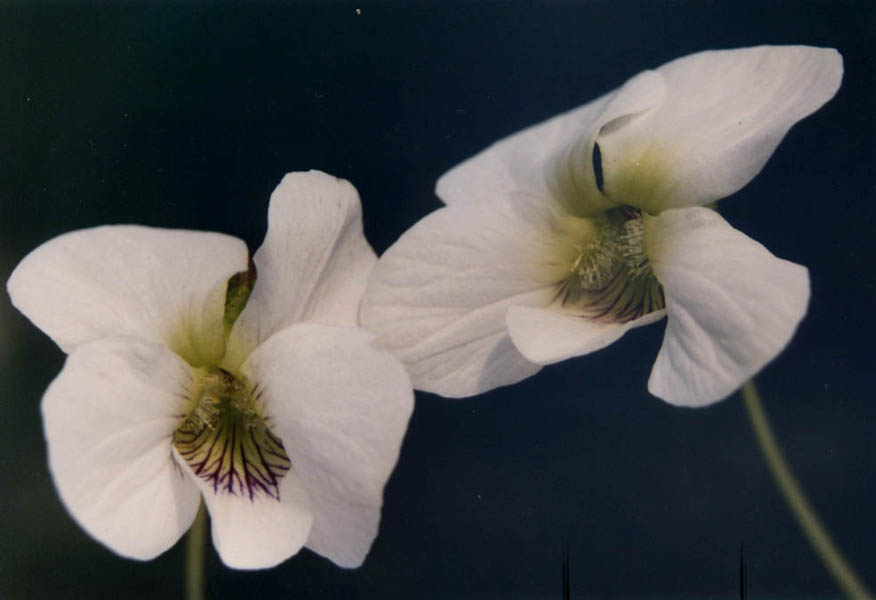
White cultivar of Viola cucullata, a perennial from the Violaceae family, whose type species is native to eastern North America. It grows there in moist meadows, stream banks, bogs, and cool undergrowth, from sea level to the montane zone.
It forms a clump without an apparent stem, 15 to 25 cm tall in flower, with long-petioled, heart-shaped leaves, bright green, slightly hooded when young, which earned it its specific epithet.
The flowers of this cultivar are pure white, large for the genus, borne on long slender peduncles that raise them well above the foliage. The throat reveals a fine network of purple-violet veins on a greenish background, visible when looking at the flower from the front, which is a detail of great finesse and elegantly contrasts with the whiteness of the petals.
In its natural habitat, the flowering of the type species extends from April to June. In cultivation, this cultivar generally blooms in April-May.
Viola cucullata also produces cleistogamous flowers, unopened, ensuring abundant fruiting even without pollinators. It naturalizes easily by spontaneous seeding in suitable conditions.
It requires constantly fresh to moist soil, rich in humus, in partial shade or light shade. It is suitable for moist woodland gardens and the edges of water features.