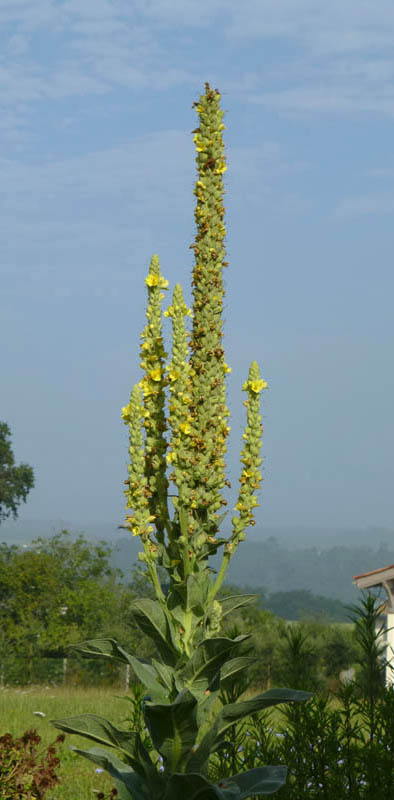
Biennial of the Scrophulariaceae family, the great mullein is one of the most widespread wild plants in Europe, Western Asia, and North Africa. Naturalized on all temperate continents, it colonizes embankments, roadsides, wastelands, screes, and dry fallows, always in full sun and on well-drained substrates.
The first year, it develops an imposing basal rosette of large oval-lanceolate leaves, thick, entirely covered with a dense gray-white woolly tomentum on both sides, giving a felt-like touch. The second year, it raises a single, robust, unbranched stem, reaching 150 to 200 cm, itself covered with gray wool. The terminal, tight, cylindrical spike bears pale yellow to sulfur yellow flowers that open progressively and irregularly, a few at a time, over a very long period.
In its natural habitat, its flowering extends from June to September. Its leaves were once used in folk medicine for their soothing properties, and the dried stems, soaked in fat, served as torches, hence some of its vernacular names.
It requires no particular care, reseeds abundantly, and establishes itself spontaneously in any poor, dry, and well-exposed soil.