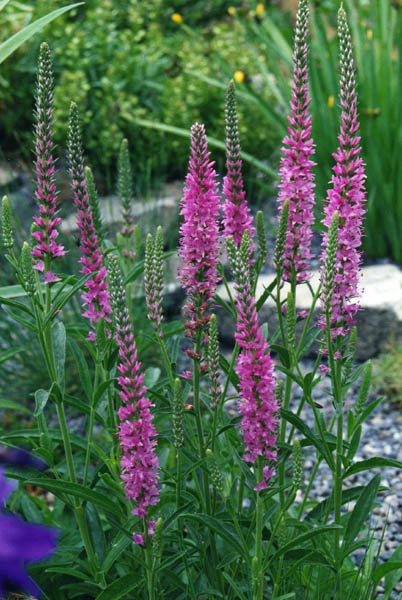
Cultivar of Veronica spicata, a perennial of the Plantaginaceae family, whose type species is widely distributed in Europe and Asia, from dry and calcareous plains to lower mountain levels. This pink-flowered cultivar is selected for its color, which contrasts with the more common blue and purple forms of the species.
It forms an upright and vigorous clump, reaching 40 to 60 cm in height in cultivation, with rigid stems bearing lanceolate, opposite, medium green leaves that are slightly toothed. The habit is distinctly vertical, with no tendency to spread.
The flowers are a deep pink to magenta pink, gathered in long, dense, and tapered terminal spikes, characteristic of the species. The spike gradually elongates from the base to the top, with still-closed buds forming a grayish tip contrasting with the open flowers below, giving the flowering stem a particularly slender appearance.
In its natural habitat, the flowering of the type species extends from June to August depending on altitude and latitude. In cultivation, this cultivar generally blooms from July to August, with a possible rebloom if the faded spikes are cut.
It thrives in full sun, in well-drained soil, even poor and calcareous. Hardy and undemanding, it is suitable for both flower beds and natural-style gardens.