Perennial from the Plantaginaceae family, this creeping speedwell is native to Turkey, where it grows on rocky and dry alpine lawns in Anatolia. It is an uncommon species in cultivation, appreciated by rock garden enthusiasts for its ground-covering behavior and hardiness.
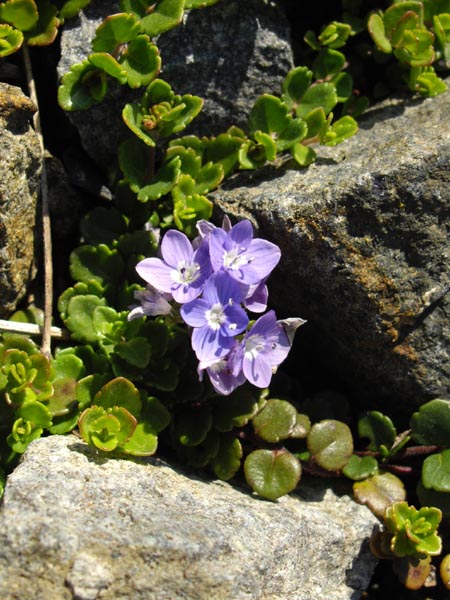
It forms a dense and tight carpet, strictly prostrate, only 2 to 5 cm in height, gradually spreading between and over rocks. The leaves are very small, rounded to kidney-shaped, with crenate edges, a shiny bright green slightly glossy, which clearly distinguishes them from several other Turkish speedwells with dull or grayish foliage.
The flowers, borne in small groups at the foliage level, are pale blue-lilac to medium blue, with a well-visible white eye. Their modest size contrasts with the overall effect produced when the plant blooms abundantly, covering a rocky surface.
In its natural habitat, its flowering extends from May to June. In cultivation, it often blooms as early as April-May.
It requires full sun, a perfectly drained, gravelly or sandy soil, and withstands summer drought well once established. Excellent for paving gaps, walls, and flat rockeries, it is vigorous without being invasive.