Perennial of the Plantaginaceae family, this veronica is native to Eastern Europe and Central Asia, from the steppes of Russia and Ukraine to Siberia. It naturally grows in dry lawns, grassy steppes, and sunny rocky slopes, on poor and well-drained soils.
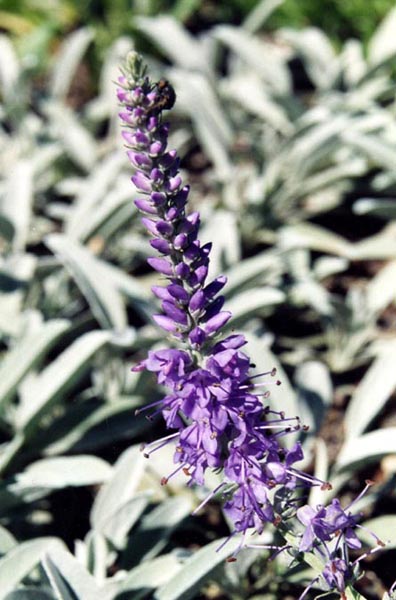
It forms low and spreading clumps, at most 15 to 25 cm in height, remarkable even before flowering for its foliage entirely covered with a dense white-silver tomentum that gives the plant an almost lunar appearance. The leaves are lanceolate to oval, with crenate edges, uniformly gray-white on both sides.
The flowers are gathered in fairly short and dense terminal spikes, of a deep blue-violet to violet. The contrast between the color of the flowers and the silver of the foliage constitutes one of the sharpest visual effects of the genus in cultivation.
In its natural habitat, its flowering extends from June to August. In cultivation, it generally blooms from June to July.
It requires full sun and well-drained soil, even poor and dry. Stagnant moisture is unfavorable to it, especially in winter. Hardy and undemanding once established, it is suitable for rock gardens, dry borders, and compositions playing on foliage contrasts.