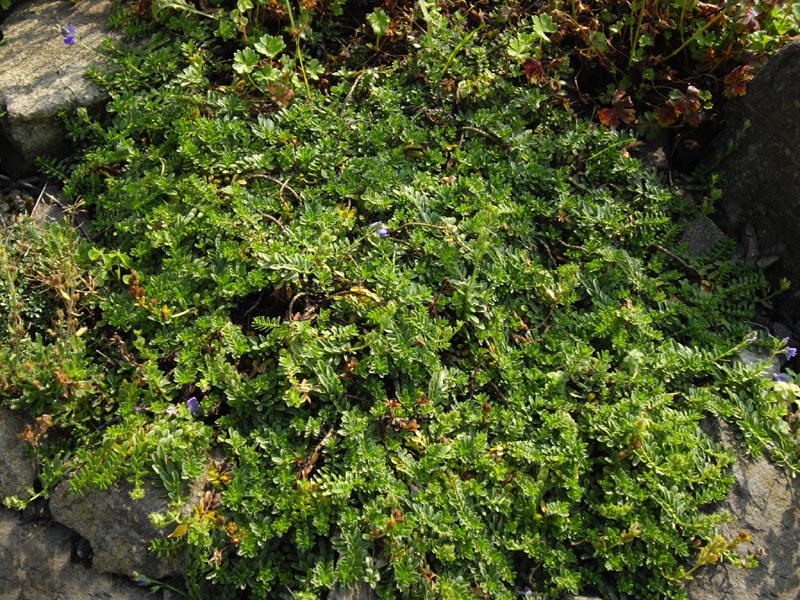
Perennial of the Plantaginaceae family, this subshrubby veronica is found in the mountains of Europe, from the Pyrenees to the Carpathians and the Alps, as well as in Scandinavia. It occupies rocks, stabilized scree, cracks, and rocky high-altitude lawns, generally between 1,500 and 3,000 meters, on varied substrates, siliceous or calcareous.
It forms spreading clumps with creeping then erect stems, woody at the base, 3 to 5 cm in height, gradually covering large areas by leaning on rocks or carpeting the ground. The leaves are small, oval, thick, with a shiny green, slightly toothed edges, densely arranged along the stems.
The flowers, borne in short terminal clusters, are bright blue to intense blue-violet, with a well-marked white-greenish eye in the center. The two protruding stamens, white, add to the clarity of the corolla. This pure blue, among the purest of the genus in Europe, is the most immediately striking feature of the species.
In its natural habitat, its flowering extends from July to September depending on the altitude. In cultivation, it generally blooms from June to August.
It requires a sunny exposure, well-drained, gravelly soil, neither too rich nor too dry. More accommodating than the veronicas of Anatolia, it is well-suited to outdoor rock gardens and withstands cold winters without special protection.