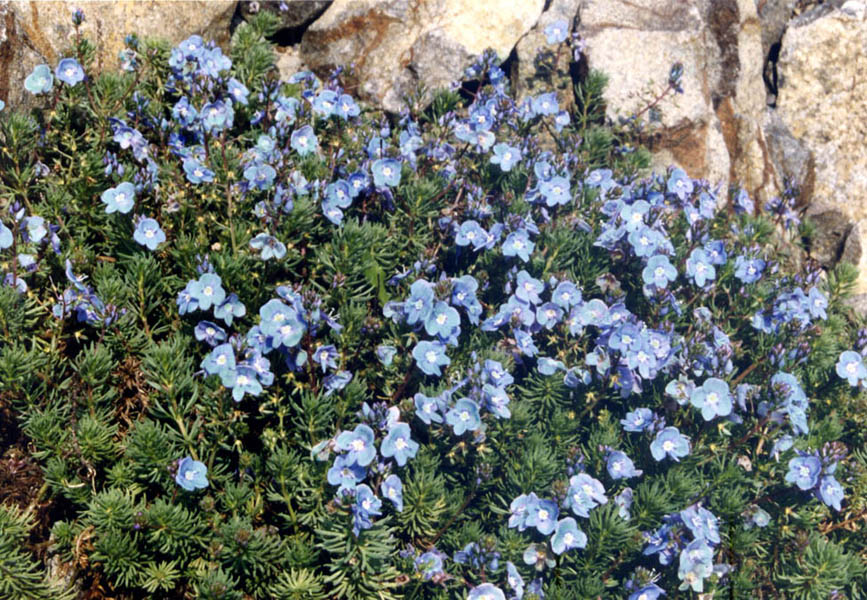
Perennial of the Plantaginaceae family, this dwarf speedwell is native to Armenia and eastern Turkey, where it grows on dry rocky areas, high-altitude steppe grasslands, and well-exposed rocky slopes, generally between 1,500 and 2,500 meters.
It forms dense, very compact and persistent cushions, barely 8 cm in height, made up of small, finely cut, almost needle-like leaves, of a medium green to green-gray, giving the plant at rest an almost ericoid appearance. This small, tight foliage is one of the most distinctive features of the species among dwarf rock garden speedwells.
At the time of flowering, the cushion almost entirely disappears under a profusion of small four-petaled flowers, of a lilac blue to bright violet blue, with a white eye and fine darker veins, borne on short upright stems. The variability in shade, from pale blue to deeper violet-blue, is notable from one individual to another.
In its natural habitat, its flowering extends from May to June; in cultivation, it generally occurs in April-May depending on the climate.
It requires very well-drained, even gravelly soil, in full sun, and fears stagnant winter moisture. Its cultivation in rock gardens, troughs, or collection pots perfectly suits its requirements, and its hardiness is generally good.