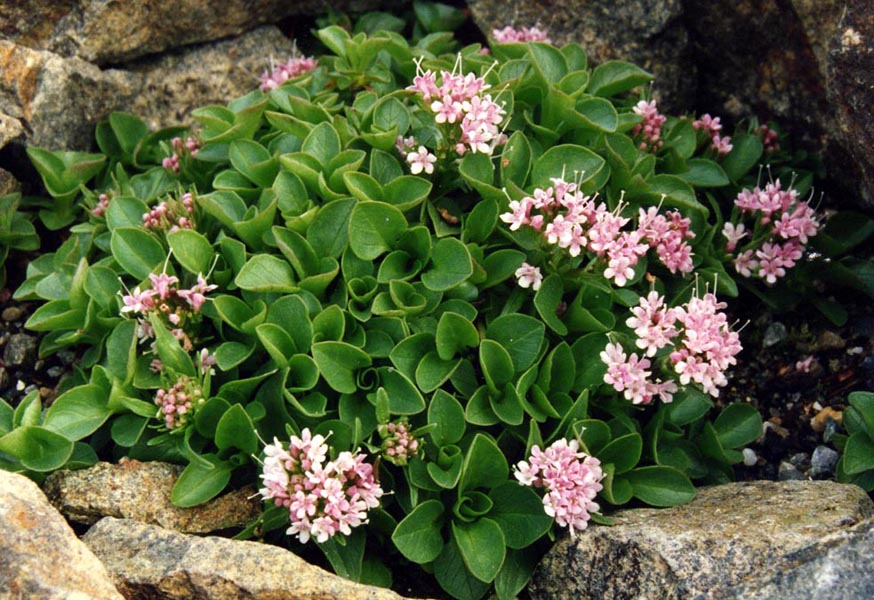
It is one of the smallest European valerians. It forms low and dense cushions or mats, barely exceeding 5 to 10 cm in height when in bloom. The leaves are small, oval to spatulate, entire, bright green and slightly shiny, borne by prostrate to ascending stems that spread between the stones. This prostrate habit and the compact and fleshy foliage for the genus are its most characteristic features.
The flowers are gathered in small tight terminal corymbs, from soft pink to deep pink, with prominent stamens that give them an airy appearance despite their small size. In its natural habitat, its flowering extends from July to August; in cultivation under our latitudes, it generally occurs in June-July.
In cultivation, it requires calcareous, very well-drained, poor soil, in full sun, with good winter protection against stagnant moisture. It is suitable for rock gardens in calcareous soil, alpine gardens, and specialized containers.