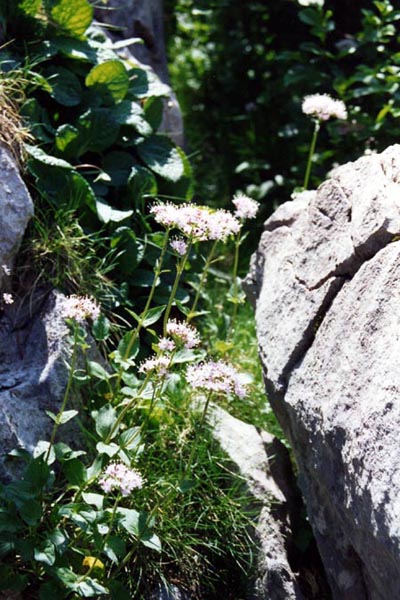
- photographed in the Pyrenees -
- photographed in the Pyrenees -
A perennial of the Valerianaceae family, this mountain valerian is widespread in the mountain ranges of southern and central Europe, from the Pyrenees to the Alps, the Apennines, and the Balkans. It is strictly confined to high-altitude limestone environments, colonizing screes, rocks, crevices, and well-drained stony slopes, generally between 800 and 2,500 meters.
It forms upright and light clumps 20 to 35 cm in height. The basal leaves are oval to elliptical, entire or very slightly toothed, dark green and shiny, distinctly different from the pinnate leaves of the large officinal valerian, allowing for unambiguous identification. The cauline leaves are few and smaller.
The flowers are gathered in dense and rounded terminal corymbs, pure white to slightly pink, borne on thin and well-branched stems that give them an airy lightness. Seen en masse in their natural habitat, among the limestone blocks, they form sheets of great freshness. In its natural habitat, its flowering extends from June to August depending on the altitude.
In cultivation, it requires a limestone, well-drained, rather poor soil, in a sunny to semi-shaded exposure. It integrates naturally into limestone rockeries and between the stones of walls, where it can reseed spontaneously.