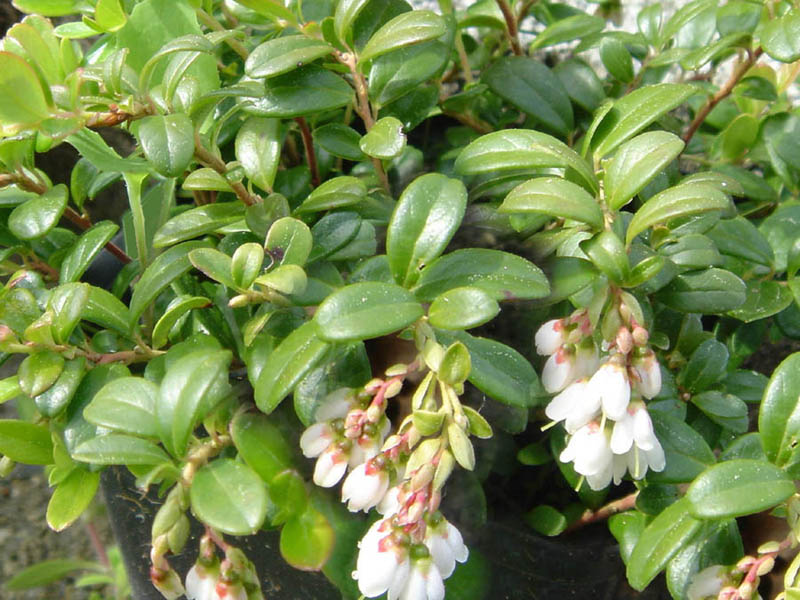
Small evergreen shrub of the Ericaceae family, the lingonberry or mountain cranberry is widespread throughout boreal and mountainous Europe, from Scandinavia to the Alps, the Pyrenees, and the Carpathians, as well as in northern Asia and North America. It occupies heathlands with ericaceous plants, clear coniferous undergrowth, peat bogs, and rocky acidic grasslands, from northern plains up to more than 2,500 meters in the alpine massifs.
It forms low and dense mats or cushions, rarely beyond 15 to 25 cm in height, spreading slowly through underground stolons. The evergreen foliage is one of its most immediately distinctive traits compared to the common bilberry: the leaves are oval, leathery, dark glossy green on the upper side, dotted with small brown-blackish spots on the underside, with slightly rolled edges.
The flowers, gathered in small terminal drooping clusters, are fine pure white to slightly pinkish bells, with reddish sepals contrasting nicely with the corolla. In its natural habitat, its flowering extends from May to July depending on altitude; in cultivation under our latitudes, it generally occurs in May-June.
The bright red, tangy berries are edible and widely used in Scandinavian and Central European cuisines, in jellies and sauces accompanying game. Their traditional harvest is still common in many mountainous regions.
In cultivation, it requires acidic, peaty or sandy soil, fresh, without limestone, in a semi-shaded to sunny exposure. It is perfectly suited to heather gardens, rockeries in acidic soil, and naturalized compositions.