Perennial of the Cyperaceae family, native to New Zealand, where it grows in forests, wooded edges, and wet meadows, from sea level to altitude. The genus Uncinia is closely related to sedges (Carex), from which it is mainly distinguished by a singular botanical feature: the central vein of each floral bract extends into a rigid hook protruding beyond the utricle, adapted for dispersal by attachment to animals and clothing.
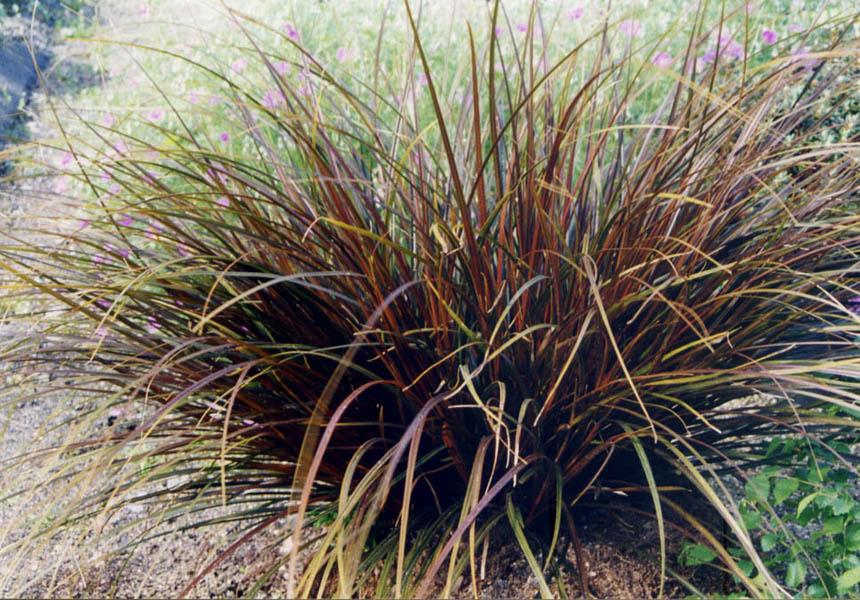
It forms a dense, rounded, and arched tuft, 40 to 60 cm in height, with long, narrow, ribbon-like leaves falling in all directions. The coloration is one of its most remarkable assets, blending reddish-brown, coppery, orange, and olive green tones depending on the season, exposure, and growing conditions, with an intensity that varies considerably from one individual to another.
The floral spikes are discreet, dark brown, borne on slender stems that are lost in the foliage.
In its natural habitat, flowering mainly extends in spring and summer.
In cultivation, it prefers fresh, well-drained but not dry soil, in full sun or light partial shade; it is the sunny exposure that most intensifies the coppery hues of the foliage. Its hardiness is limited and it does not withstand very cold winters without protection; it is more reliable in regions with mild and humid climates.