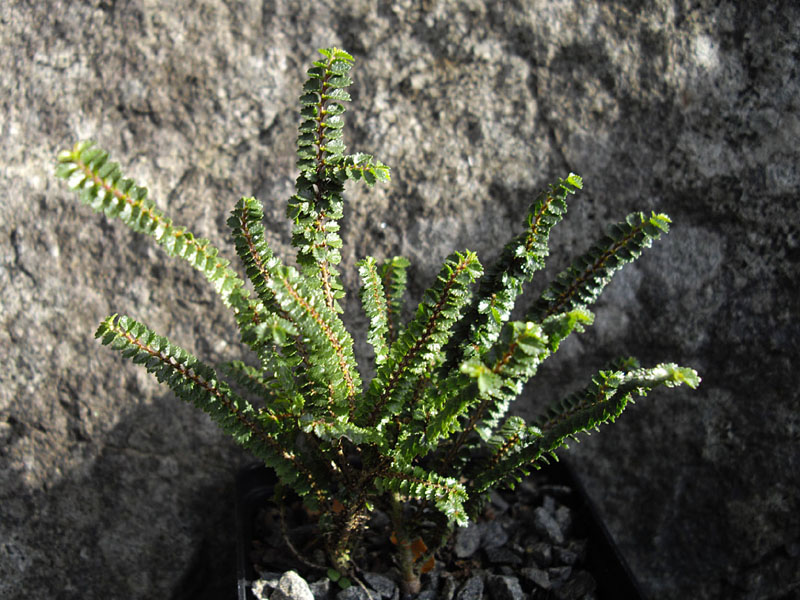
Deciduous dwarf tree of the Ulmaceae family, this miniature cultivar is derived from Ulmus davidiana, a species native to northern China, Korea, Japan, and eastern Russia. 'Pygmaea' is an extremely slow-growing form, selected for rock garden and pot cultivation.
Very compact bushy habit, with upright to slightly spreading branches, probably reaching only a few dozen centimeters after many years of cultivation. The stems are slender, reddish-brown, densely leafed along their entire length, giving a striking miniaturization aspect that spontaneously recalls the aesthetics of bonsai.
The leaves are characteristic of the genus, oval, with a double-toothed edge, but here reduced to very small dimensions, dark green glossy on the upper side, arranged in two well-ordered alternate rows along the branches. Their texture is slightly rough, with marked veins. The young stems have a visible reddish pubescence.
The flowers, insignificant as in all elms, appear in early spring before the leaves.
It should be noted that horticultural documentation on this specific cultivar is limited; precise long-term growth data remains difficult to verify with certainty.
It is cultivated in full sun to partial shade, in well-drained soil. Particularly appreciated in container or trough culture, where its slow growth and finely structured foliage can be closely observed.