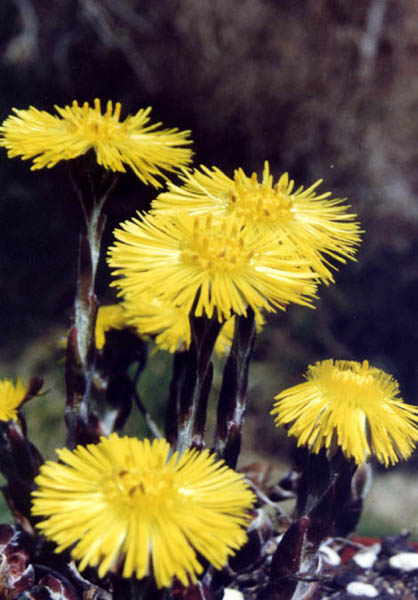
Rhizomatous perennial of the Asteraceae family, widely spread in Europe, temperate Asia, and North Africa. Naturalized in many other regions of the world. It colonizes bare ground, clayey slopes, riverbanks, scree, and debris, from sea level up to about 2,500 meters in the mountains.
Distinctive and immediately recognizable growth habit at the time of flowering, as the flowering stems appear well before any leaves. These upright stems, 10 to 15 cm tall, are covered with overlapping brown-purple to reddish-brown scales, slightly cottony, giving them a strange and archaic appearance. The capitula are solitary, bright yellow, composed of numerous very narrow ligulate florets on the periphery and tubular florets in the center, giving a dense and bristly texture that is well characteristic.
The leaves, large, heart-shaped, long-petioled, medium green above and white-tomentose below, appear only after flowering and persist all summer, then forming a vigorous ground cover.
In its natural habitat, its flowering extends from February to April depending on altitude and exposure, making it one of the first flowering plants of the year.
Long used in traditional medicine as an expectorant and respiratory soother, it is known by the popular name of coltsfoot, in reference to the shape of its leaves. Its creeping rhizome gives it a great colonization capacity, to be considered before any introduction into the garden.