syn. Tulipa whittallii
syn. Tulipa whittallii
Bulbous perennial of the Liliaceae family, native to Greece, western Turkey, and the Balkans, where it grows on rocky slopes, garrigues, fields, and roadsides, generally between 200 and 1,500 meters altitude according to sources.
Medium size for a botanical tulip, reaching 20 to 35 cm in height. The leaves are broad, glaucous to gray-green, wavy at the edges, upright then spreading; their bluish tint provides a particularly harmonious background with the warm tones of the flower.
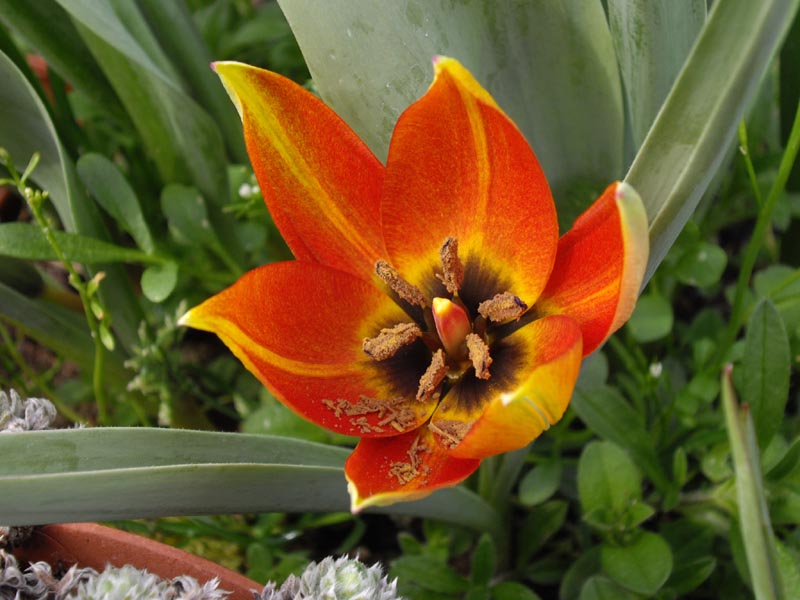
The buds are streaked with pale yellow and green on a dull orange background on the outside, revealing when open intense orange-vermilion tepals, more yellow at the base, with lighter, well-visible veins. The central blotch is deep black-brown, encircled by a bright yellow-orange ring, with large dark chocolate-brown anthers that contribute to the dark and contrasting appearance of the heart. The tepals are pointed, slightly concave, giving the open flower an irregular and animated star shape. Each stem can bear several flowers, which is a notable feature in the genus.
In its natural habitat, its flowering extends from April to May. In cultivation, it occurs in April mid-season.
It tolerates heat and slight spring humidity better than many tulips from Central Asia, and naturalizes quite well in well-drained soil in full sun. Suitable for rock gardens, sunny slopes, and Mediterranean gardens.