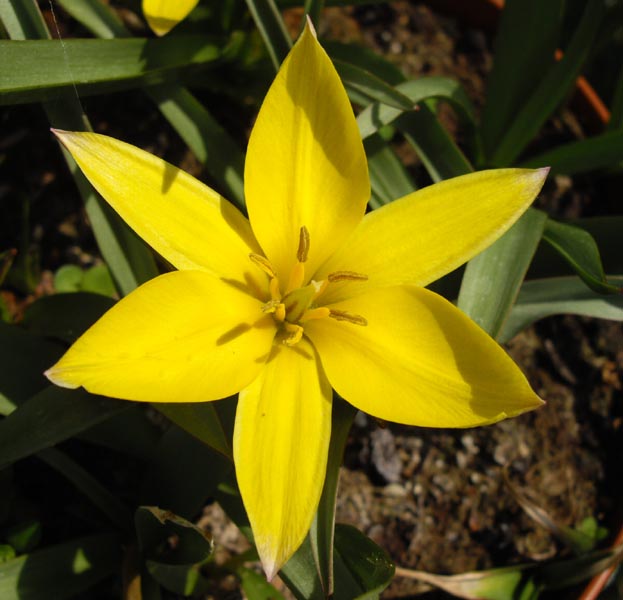
Bulbous perennial of the Liliaceae family, native to northwestern Iran, in the region of Lake Urmia, as well as northern Iraq. It grows on rocky slopes and dry alpine meadows, in conditions of marked winter cold and pronounced summer drought.
Very low and spreading habit, reaching only 8 to 15 cm in height. The leaves are narrow, medium green to slightly glaucous, lying flat to semi-spread at ground level, giving the plant a particularly compact appearance. Each bulb can produce several flowering stems simultaneously, each bearing one to two flowers.
The flower opens into a very flattened wide star with oval-pointed tepals, a bright and pure yellow, uniform over the entire inner surface. The outside of the tepals may have a slight greenish or pale bronze tint. The center is occupied by entirely yellow stamens, without a contrasting dark spot, giving the open flower an unusual tonal uniformity in the genus. The purity and clarity of this bright yellow in the sun is its most immediately striking feature.
In its natural habitat, its flowering extends from March to April. In cultivation, it blooms early in the season, in March to April.
It requires full sun, very well-drained soil, poor to moderately fertile, and tolerates summer drought well. Its small size and tendency to multiply in clumps make it a particularly valuable species for low rock gardens and shallow container cultivation.