syn. Tulipa batalinii
syn. Tulipa batalinii
Bulbous perennial of the Liliaceae family, this botanical tulip is native to Central Asia, mainly from Tajikistan, Uzbekistan, and adjacent regions. It grows on rocky slopes and arid steppe hills, on light and well-drained substrates, at moderate altitudes.
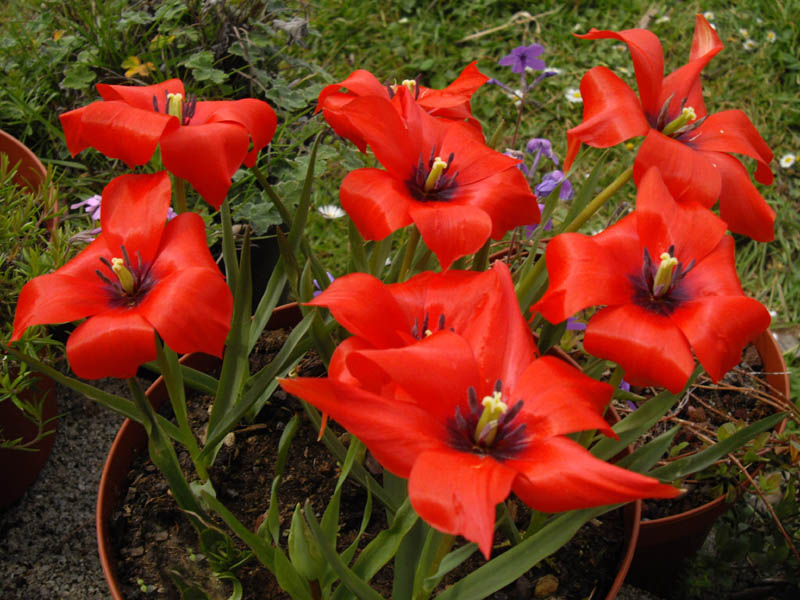
The plant is small, reaching 10 to 20 cm in height. The leaves are narrow, linear, glaucous with slightly wavy and ciliated edges, arranged in a low rosette. A well-established bulb can produce several flowering stems simultaneously, as clearly confirmed by the photographs.
The fully open flower takes on a distinctly star-shaped form, with the six pointed tepals spreading widely. Their color is an intense and satin scarlet red, enhanced at its center by a well-defined purple-black blotch, from which emerge stamens with dark anthers and a pale yellow pistil — a striking contrast and immediate characteristic of the species.
In its natural habitat, its flowering extends from April to May. In cultivation, it generally blooms in April.
It requires perfect drainage, full sun exposure, and pronounced summer dryness. It shows particularly well in a pot under cold shelter or in a very well-drained rock garden, where it gradually multiplies by bulbils.