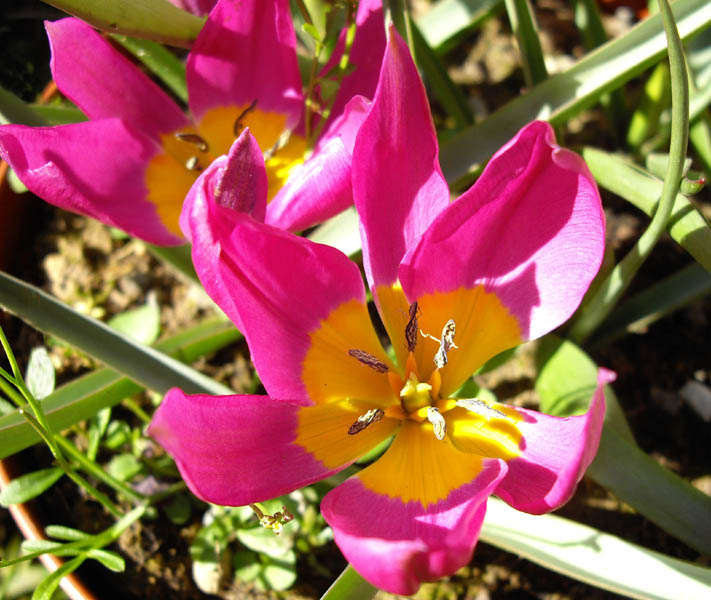
Bulbous perennial of the Liliaceae family, native to southeastern Turkey, Iran, Iraq, and the Caucasus. It grows on rocky slopes, scree, and high-altitude steppes, on well-drained substrates, between about 1,000 and 3,000 meters.
It is a very small tulip, rarely exceeding 10 to 15 cm in height, with a low and spreading habit. The leaves are narrow, glaucous, channeled, often almost lying flat, sometimes edged with a red margin.
The flowers open widely in the sun into a flared cup with six oval tepals, in a bright and luminous pink-magenta to pink-purple, with a large, well-defined central orange-yellow blotch, encircled by a fine blackish zone that accentuates the contrast. The anthers are dark brown-violet. The overall effect is a particularly intense and warm color for such a small plant.
In its natural habitat, its flowering extends from March to May depending on the altitude. In cultivation, it generally blooms in March-April, among the first botanical tulips of the season.
Nomenclatural note: Tulipa humilis is a complex group that has long encompassed several taxa now sometimes separated, including Tulipa pulchella and Tulipa violacea. The delimitation between these entities remains debated according to the authors.
It requires perfect drainage, full sun, and respect for summer dryness. Suitable for rock gardens, garden scree, and pot culture in a cold shelter.