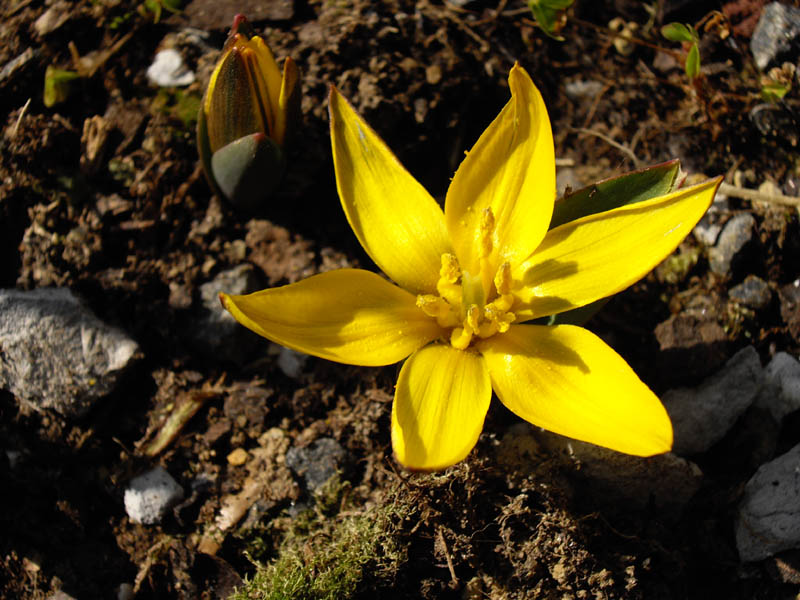
Bulbous perennial of the Liliaceae family, native to Central Asia, mainly from the Tian Shan, Pamir-Alay, and adjacent regions of Kazakhstan, Kyrgyzstan, and Tajikistan. It grows on rocky slopes and high-altitude scree, on well-drained substrates, between approximately 1,500 and 3,500 meters.
It is one of the smallest and lowest botanical tulips: it rarely exceeds 8 to 12 cm in height, often less in natural conditions. It frequently bears several flowers per stem, which immediately distinguishes it from many tulips of the same group. The leaves are narrow, glaucous, lying flat to semi-upright, often almost at ground level.
The flowers open in a wide, flat star shape in the sun, revealing six bright yellow tepals with a well-marked greenish central vein on their outer face, visible on the still-closed bud. The center is entirely yellow, with stamens bearing yellow anthers. In the shade or cloudy weather, the flower closes and the greenish-yellow striped reverse remains visible, giving a very different appearance from the open flower.
In its natural habitat, its flowering extends from April to June depending on altitude. In cultivation, it generally blooms in March-April.
Nomenclatural note: Tulipa dasystemon is sometimes confused with Tulipa tarda, which closely resembles it. The two species are similar, but Tulipa tarda has characteristic white-tipped tepals, absent in Tulipa dasystemon.
It requires excellent drainage, full sun, and respected summer dryness. Hardy and undemanding once well established, it is suitable for rock gardens, garden scree, and pot cultivation under cold shelter.