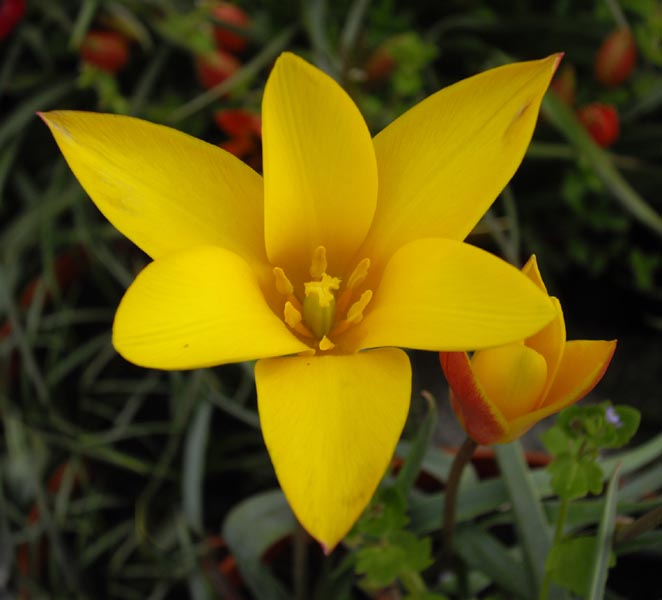
syn. Tulipa clusiana var chrysantha
syn. Tulipa clusiana var chrysantha
Bulbous perennial of the Liliaceae family, it is native to the mountainous regions of northern Iran, Afghanistan, and Pakistan, where it grows on rocky slopes and well-drained scree, between approximately 1,500 and 3,000 meters, under a climate with dry summers and cold winters.
The plant reaches 20 to 30 cm in height. The leaves are very narrow, almost cylindrical, glaucous, upright, characteristic of the species' slender habit. An established bulb produces several stems simultaneously, forming a lively and dense clump.
The bud is one of the most captivating spectacles of spring in rock gardens: the outer tepals, from a red-orange to a strong salmon-pink on their reverse, open to reveal a completely bright and luminous yellow interior. At full bloom, the flower takes on a star shape with six very spread-out pointed tepals, uniformly yellow, without visible blotch, with stamens and pistil also yellow. This transition from the bicolored bud to the pure yellow flower is one of the most immediately striking features of this tulip.
In its natural habitat, its flowering extends from April to June depending on the altitude. In cultivation, it generally blooms in April.
It requires perfect drainage, full sun, and a well-marked summer drought. It readily naturalizes in very well-drained rock gardens and proves more persistent than many botanical tulips in suitable conditions. Cultivation in pots under cold shelter is also very suitable.