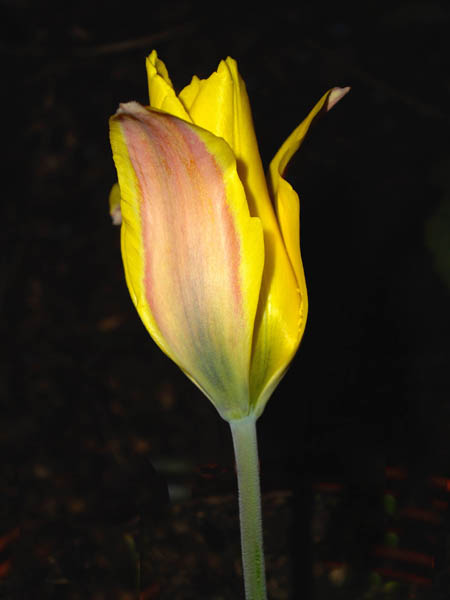
Tulipa altaica Pall. ex Spreng.
Bulbous perennial of the Liliaceae family, Tulipa altaica is native to Central Asia, mainly the Altai mountains, Tian Shan, and adjacent regions of Kazakhstan and Russia. It grows in rocky steppes, grassy slopes, and high-altitude scree, generally between 1,000 and 2,500 meters, on well-drained substrates, often poor and stony.
It is a small plant, reaching 15 to 25 cm in height, with glaucous leaves, quite broad, with slightly wavy edges, forming a discreet but well-present base. A single bulb can produce several flowers in cultivation.
The fully open flower is one of the most striking spectacles among yellow botanical tulips: the six pointed tepals spread widely in a regular star, of a bright and luminous yellow, without a blotch at the base, with stamens and pistil also yellow. The bud offers a completely different appearance, the outer tepals displaying a salmon-pink to pinkish-beige reverse that fades upon full opening.
In its natural habitat, its flowering extends from May to June depending on altitude. In cultivation, it generally blooms in April.
It requires perfect drainage, full sun exposure, and a marked summer drought period, essential for the proper maturation of the bulb. It is successfully cultivated in well-drained rock gardens or in pots under cold shelter.