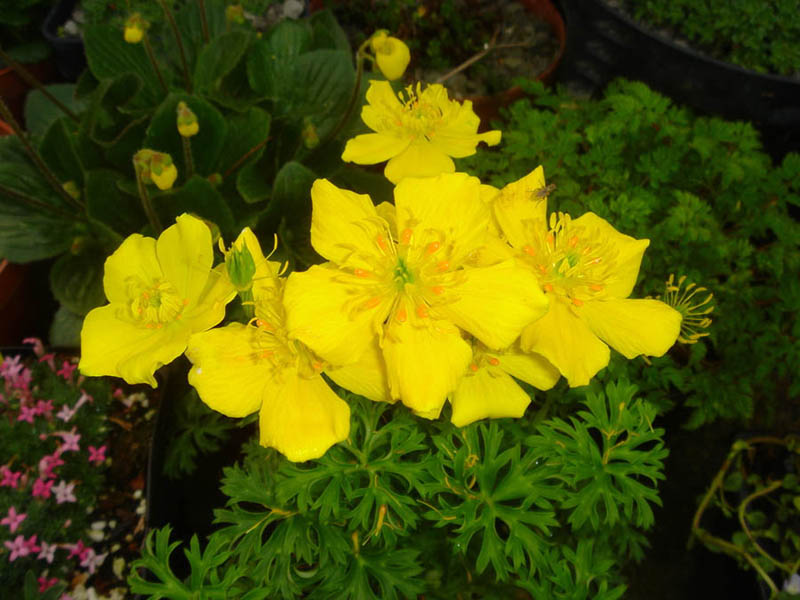
Perennial of the Ranunculaceae family, native to the mountains of Central and Eastern Asia, from the Himalayas to Tibet and southwestern China. It frequents moist alpine meadows, stream banks, and stabilized screes with cool soil, generally between 3,000 and 5,000 meters altitude.
It is the quintessential dwarf globe flower. The plant forms a low, compact clump, reaching 10 to 20 cm in bloom, with finely cut palmate-lobed leaves, a bright and shiny green, very ornamental in themselves. This cut foliage, almost ferny, carpets the ground even before the flowers appear.
The flowers are widely open and spread out, with five petaloid sepals of a bright and luminous yellow, framing a center adorned with orange nectaries and numerous stamens that warm the heart of the flower with a golden touch. This open structure, in contrast to the globular forms of European globe flowers, is characteristic of the species and gives it an almost buttercup-like lightness.
In its natural habitat, its flowering extends from June to August depending on the altitude. In cultivation, it generally blooms from May to June.
It requires cool to moist soil, well-drained in depth, rich in humus, in full sun or light partial shade. It is suitable for cool rock gardens, alpine gardens, and containers, provided the substrate never completely dries out in summer.