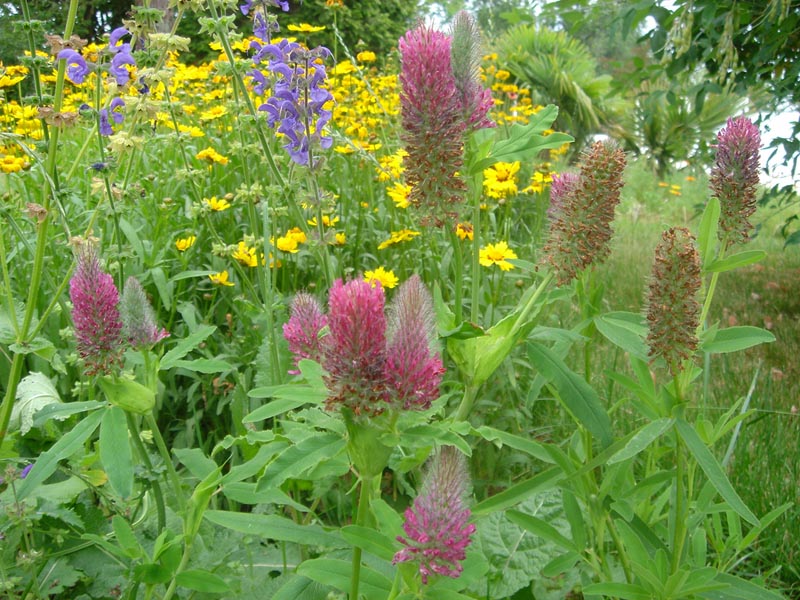
Perennial of the Fabaceae family, present in Central and Southern Europe, from the Iberian Peninsula to the Balkans and Asia Minor. It occupies forest edges, dry grasslands, and thermophilic fringes on calcareous or neutral soils, generally in plains and hills, up to about 1,000 meters.
The plant forms an upright clump, reaching 30 to 50 cm, with robust and slightly branched stems. The leaves are trifoliate, with narrowly elliptical leaflets, significantly more elongated than those of the common clover, finely toothed, with a glossy medium green. This sober and slender foliage pleasantly contrasts with the amplitude of the inflorescences.
The spikes are cylindrical and elongated, reaching 5 to 7 cm in length, much larger than those of most European clovers. The flowers are a deep rose-carmine to purple, tightly packed in remarkable density, and the calyxes bear long silvery silky hairs that give the whole a vaporous and luminous appearance, particularly visible in backlight. It is this combination of the intense color of the corollas and the silky texture of the calyxes that makes the species' character immediately recognizable.
In its natural habitat, its flowering extends from June to July. In cultivation, it is undemanding, requiring well-drained, rather dry soil, in full sun. It is suitable for flower meadows, embankments, and natural borders, and is appreciated by pollinators.