syn. Campanula jacquinii
syn. Campanula jacquinii
Perennial from the Campanulaceae family, native to the Eastern Alps and Northern Balkans, where it colonizes cracks in limestone rocks, cliffs, and consolidated screes, generally between 800 and 2,000 meters. It is named after the Austrian botanist Nikolaus Joseph von Jacquin.
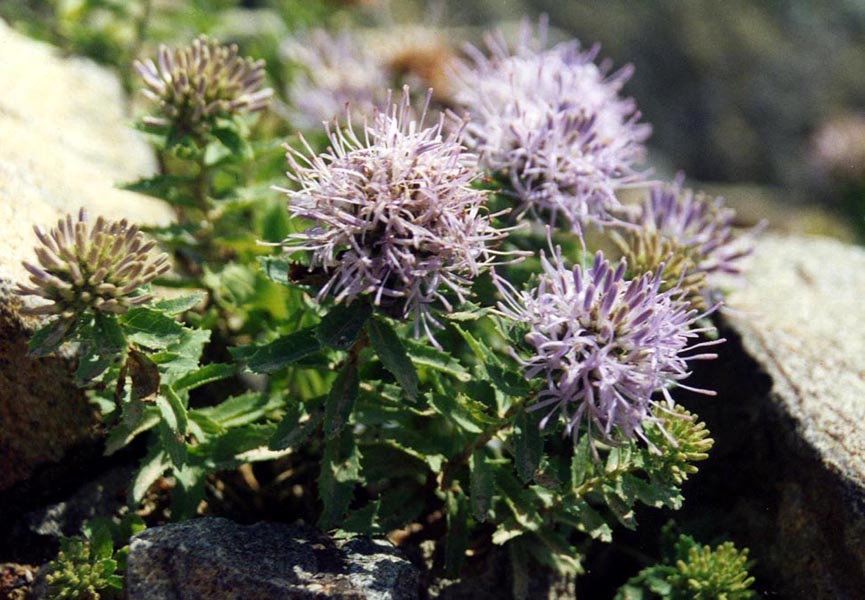
The plant forms a low and compact tuft, with short, upright stems, rarely exceeding 8 to 12 cm in bloom. The leaves are oval to oblong, slightly toothed, medium green, pubescent, arranged in basal rosettes and along the flowering stems.
The most striking feature of the species is the shape of its inflorescences, which radically differ from the usual bell-shaped type of the genus. The flowers are gathered in very dense globular heads, from pinkish lilac to pale mauve, with narrow tubes and very cut and prominent lobes that give each floral head a bristly and almost spherical appearance, more reminiscent of a Jasione or a Phyteuma than a classic bellflower.
In its natural habitat, its flowering extends from June to August. In cultivation, it generally occurs in June-July. It requires a limestone substrate, very well-drained, in a sunny to semi-shaded exposure, with protection against excessive moisture in winter. It is a collector's plant appreciated for the originality of its floral habit.