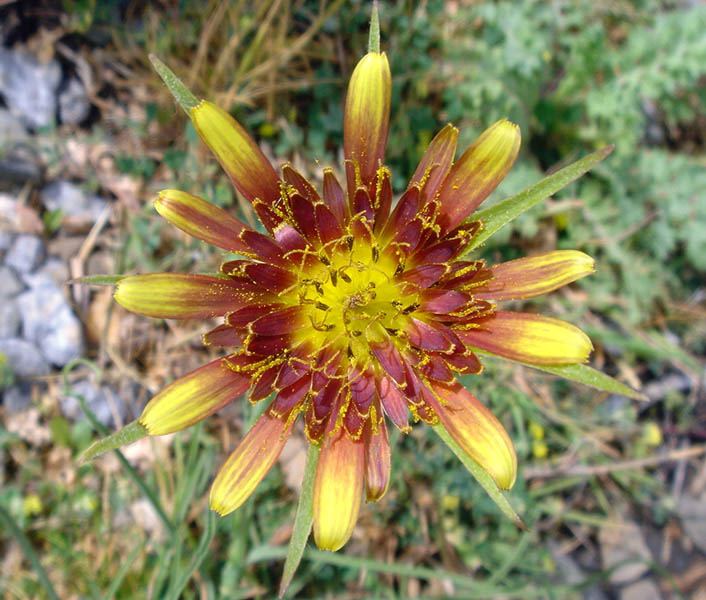
photographed in Spain
photographed in Spain
Perennial or biennial of the Asteraceae family, widespread in the western Mediterranean basin, from the Iberian Peninsula to Italy, Greece, and the Maghreb. It occupies dry grasslands, garrigues, roadsides, and well-exposed stony grounds, in plains and up to mid-altitude.
The plant is erect, reaching 20 to 50 cm, with linear to narrowly lanceolate, elongated leaves, reminiscent of those of a crocus or saffron, which is reflected in its epithet — crocifolius literally meaning "with crocus leaves". The stems are slender, bearing a solitary terminal capitulum.
The flower is the most striking element of the species. The ligules display a very marked bicoloration, bright yellow on the reverse and outer edge, and reddish-brown to dark purple on the inner face, creating a radiant and contrasting effect uncommon in the genus. The bracts of the involucre, green and elongated, clearly exceed the ligules, a typical characteristic of Tragopogon.
In its natural habitat, its flowering extends from April to June, with the capitula opening in the morning and closing in early afternoon, a usual behavior in Tragopogon. In cultivation, it requires well-drained soil, dry to fresh, in full sun, and readily reseeds itself.