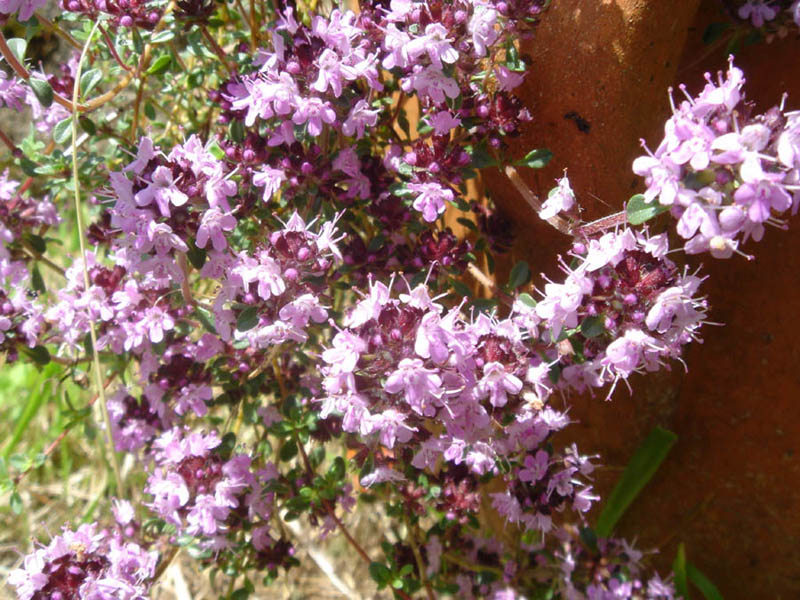
Sub-shrub of the Lamiaceae family, this third form is distinctly different from the previous two by the color of its flowers, a bright and intense pink-purple to violet-purple, among the most intense observed in this group. The photos taken in a natural rocky environment show a plant forming low and dense carpets, strictly prostrate, fitting into the crevices between granite or schist blocks, in a context reminiscent of rocky alpine lawns.
The leaves are small, oval, bright green, borne on thin reddish stems. The calyces, clearly visible at flowering, are also distinctly colored red-purple, which further enhances the depth of the overall hue, with leaves and flowers blending into a colorful carpet of great visual density.
In cultivation, this form produces a remarkably uniform covering carpet, as evidenced by the overall view in the garden. In its natural environment, its flowering extends from July to August depending on the altitude. In cultivation at low altitude, it can bloom as early as June.
It requires a perfectly drained, lean soil, in full sunlight. Its vigor in the ground and the intensity of its flowering make it one of the most remarkable forms for rock gardens and sunny pavements.