Perennial of the Lamiaceae family, Thymus leucotrichus is native to the Balkans and Turkey, where it colonizes rockeries, stony slopes, and dry high-altitude garrigues on well-drained calcareous or siliceous substrates.
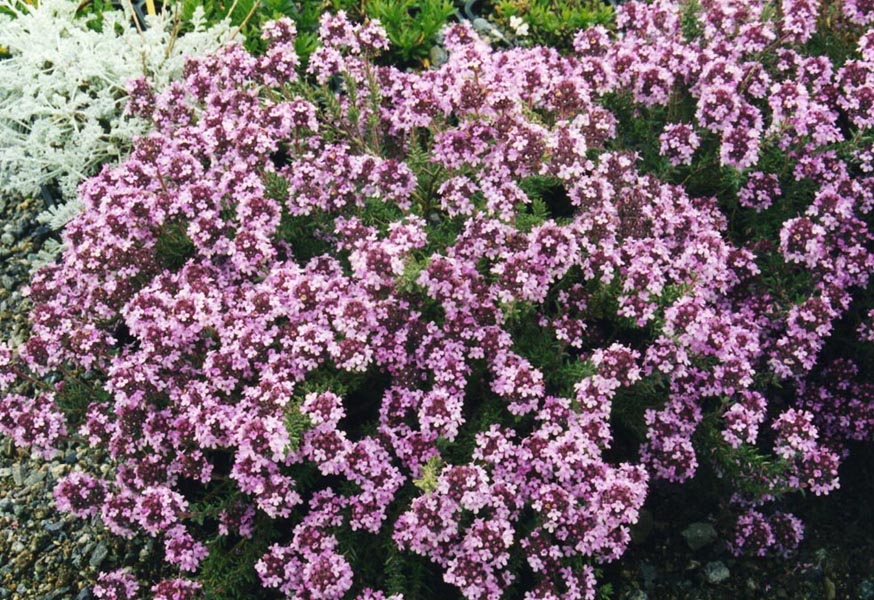
It forms dense and rounded bushy clumps, reaching 10 to 20 cm in height, with woody stems at the base and densely leafy. The small linear to narrowly elliptical leaves are edged with characteristic long white hairs, giving them a ciliated and slightly silvery appearance on the edges, which is the distinctive feature from which the species derives its name.
The flowers, lilac pink to purplish pink, are grouped in tight whorls forming compact terminal spikes. At the time of full bloom, the flower heads take on a deep purple-brown hue due to the colored calyces, creating a striking contrast with the lighter corollas. In its natural habitat, its flowering extends from June to August. In cultivation, it generally occurs from May to July depending on exposure and altitude.
It requires full sun exposure, a very well-drained soil, poor to moderately fertile, and tolerates summer drought well once established. A light pruning after flowering maintains the compactness of the clump.