Thymus lanuginosus is a purely horticultural name, widely used in commerce and gardens to designate this creeping thyme with gray and woolly foliage, but it does not correspond to any valid botanical name recognized by WFO. Formally, Thymus lanuginosus is placed in synonymy with Thymus pulegioides subsp. pulegioides, a very different thyme that is not particularly woolly.
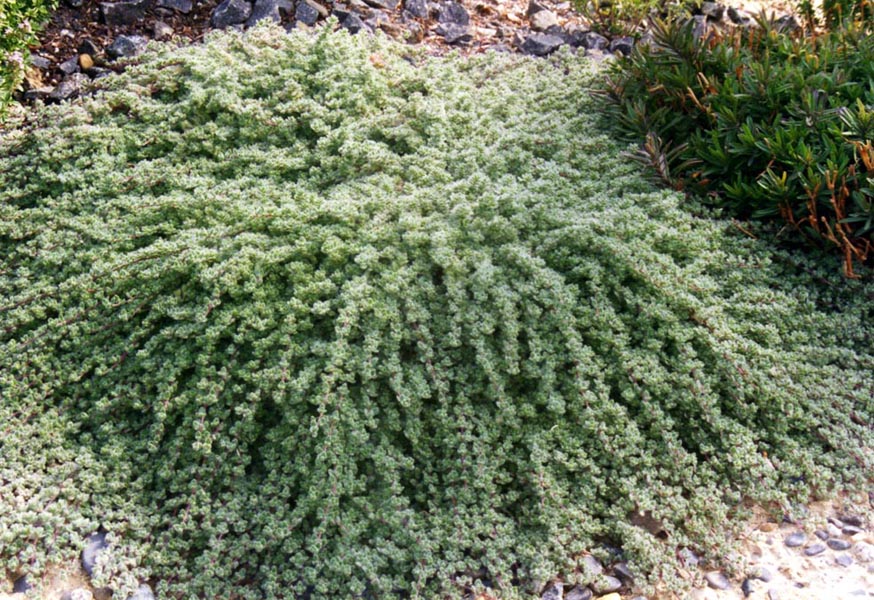
Sub-shrub of the Lamiaceae family, of European origin, this thyme forms very dense and perfectly flat creeping mats, not exceeding 2 to 5 cm in height, which gradually spread over the ground or rocks without forming any noticeable relief. It is one of the most prostrate thymes there is.
Its most immediately distinctive feature is the woolly and abundant hairiness that entirely covers stems and leaves, giving the whole a very soft and velvety silver-green hue to the touch. The small oval leaves almost disappear under this white felting. The flowers are pale pink to very light lilac, discreet, gathered in small heads. In its natural environment, its flowering extends from June to July. In cultivation, it generally occurs in May-June, often sparingly.
It requires full sun and impeccable drainage. It is above all its silver foliage and persistent woolly texture that make it a choice element for paving, wall crevices, and mineral compositions, far beyond its flowering.