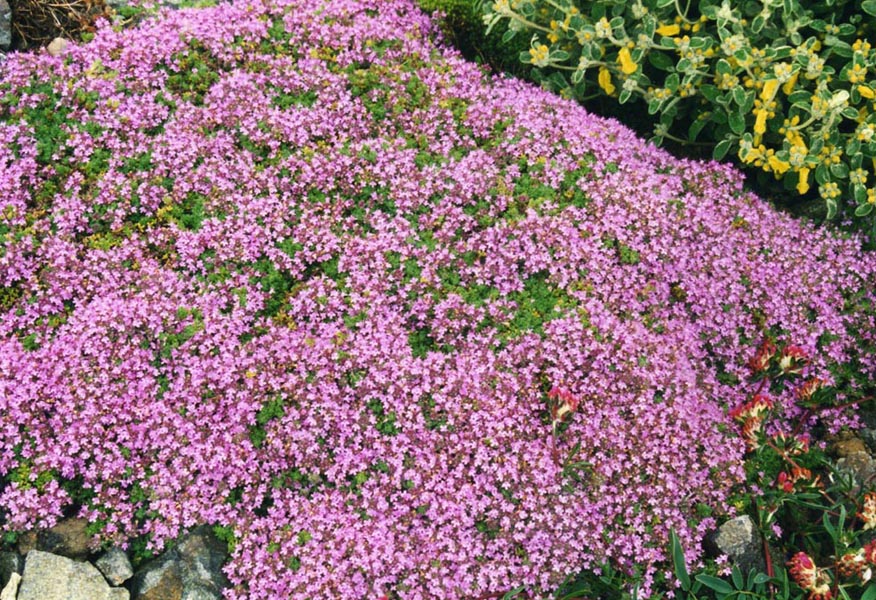
Sub-shrub of the Lamiaceae family, endemic to the Balkans, mainly from Albania and northern Greece, where it occupies rocky areas, scree, and rocky mountain slopes, generally between 1,000 and 2,000 meters approximately.
It forms creeping and very spreading mats, densely branched, barely exceeding 5 to 8 cm in height, which spread widely over rocks and stony substrate. The leaves are tiny, narrowly oval, medium to dark green, bearing well-visible cilia on their margins, a characteristic that gives the species its name and can be easily verified with a magnifying glass. The entire mat, very tight, takes on an almost mossy appearance outside of flowering.
The flowers, bright pink to fairly deep magenta pink, are produced in extraordinary quantity and literally cover the foliage at full bloom, leaving little of the green stems visible. In its natural habitat, its flowering extends from June to August depending on altitude. In cultivation, it generally occurs in May-June.
It requires full sun and perfect drainage, on poor, mineral, neutral to slightly acidic substrate. Its hardiness is good in dry conditions. The 'Bressingham' cultivar is widely distributed in horticulture and features a particularly prostrate habit and abundant flowering. It is one of the most ground-covering species of the genus, particularly effective cascading over a wall or between slabs.