Sub-shrub of the Lamiaceae family, native to North Africa, mainly Algeria and Morocco, where it grows on rocky areas, stony slopes, and open garrigues, often at altitude in mountain ranges like the Atlas, between approximately 1,000 and 2,500 meters.
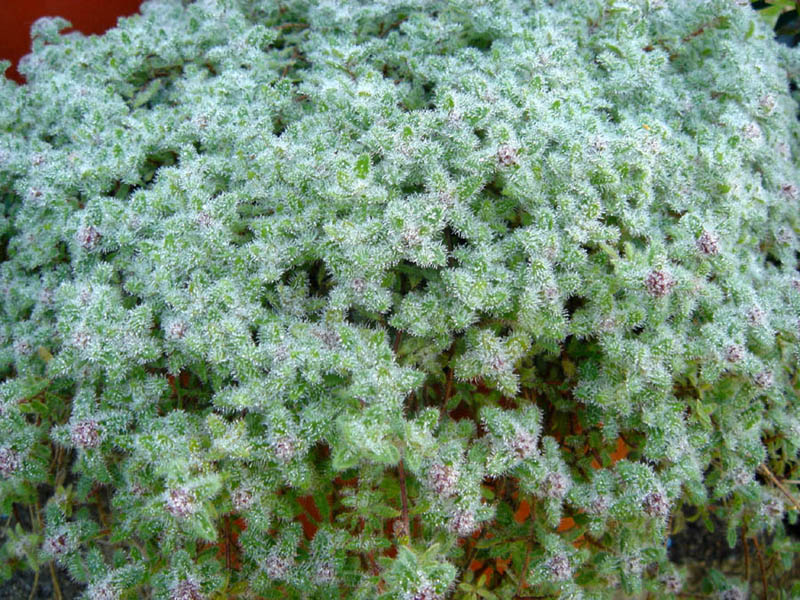
It forms dense, rounded cushions, 5 to 15 cm in height, remarkably compact. The most striking feature of the species is its abundant and very visible hairiness, with leaves and stems covered with long white hairs that give the whole a frosted, almost silvery appearance, particularly striking in low light or after morning dew.
The leaves are small, oval, of a medium green partially veiled by the hairiness. The flowers, lilac-pink to purplish-pink, are grouped in well-formed globular heads at the top of the branches, with calyces and bracts clearly colored in purplish-brown that persist and remain decorative. In its natural habitat, its flowering extends from May to July depending on altitude. In cultivation, it generally occurs in May-June.
It requires full sun, excellent drainage, and poor to moderately fertile soil. Its hardiness is adequate if the soil remains dry in winter. The silvery and downy texture of its foliage distinctly sets it apart from other thymes cultivated in rock gardens.