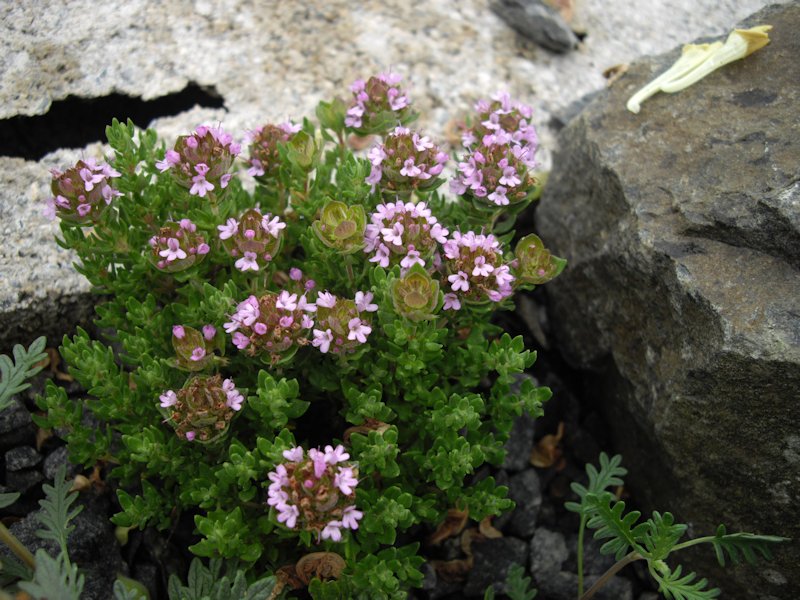
Sub-shrub of the Lamiaceae family, endemic to Portugal, where it is mainly located in the southwestern Iberian region, on the coasts and hinterland of the Algarve and coastal Alentejo. It grows on sands, rocky grounds and open garrigues, in very exposed, dry and well-drained environments, at low altitude.
It forms dense and compact, low cushions, 10 to 15 cm in height, with woody stems at the base and short upright branches. The leaves are small, oval, of a rather dark green, and emit a pronounced and characteristic camphor scent that allows it to be immediately identified when crushed, which gives it its species name.
The floral heads are rounded and well grouped at the top of the branches, with very ornamental greenish bracts with bronze or purplish reflections, which persist after flowering and contribute to the plant's appeal. The flowers are lilac pink, small, with two lips. In its natural habitat, its flowering extends from May to July.
In cultivation, it requires full sun, a very well-drained soil, poor to moderately fertile, and does not tolerate prolonged wet and cold winters. It is a species appreciated in rock gardens or containers, particularly for the texture of its cushions and the coppery color of its bracts at the time of flowering.