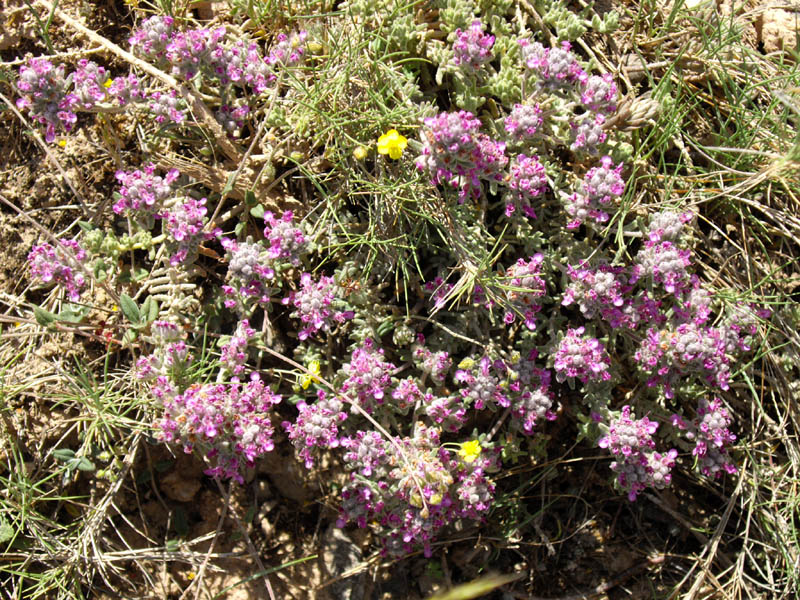
syn. Teucrium polium ssp gnaphalodes - photographed in Spain -
syn. Teucrium polium ssp gnaphalodes - photographed in Spain -
Sub-shrub of the Lamiaceae family, native to the Iberian Peninsula, mainly from Spain and Portugal, where it inhabits arid steppes, dry grasslands on poor sandy or limestone substrates, in full exposure and in a warm and bright atmosphere.
It forms a low and spreading, dense cushion, reaching 10 to 20 cm in height, with very branched woody stems. The foliage is its most immediately striking feature: the leaves are very small, narrow, entirely covered with a dense silvery white tomentum that gives the whole plant a woolly, almost mineral appearance, reminiscent of certain gnaphals or edelweiss. The flowers are bright pink to pink-purple, small, gathered in compact and numerous heads that cover the cushion at flowering time, creating a striking contrast with the silvery foliage.
In its natural habitat, its flowering extends from May to July depending on altitude and exposure.
It is an absolute drought plant, requiring full sun, very well-drained soil, sandy or gravelly, poor and dry. Any prolonged moisture, especially in winter, is fatal to it. It is suitable for very draining rock gardens, gravel gardens, or pot cultivation under cold shelter in regions with wet winters. Its hardiness to dry cold is acceptable, but it suffers from the combination of cold and humidity.