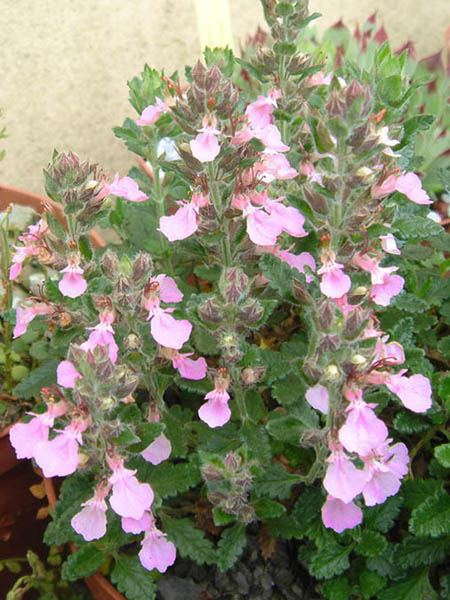
Perennial of the Lamiaceae family, Teucrium chamaedrys, the wall germander, is a species native to Mediterranean and Central Europe, present in France, Spain, Italy, and up to the Caucasus. It naturally grows on dry lawns, garrigues, limestone screes, and old walls, in full exposure, generally on well-drained calcareous substrates.
This cultivar forms a dense and spreading sub-shrub, with woody stems at the base, reaching 15 to 25 cm in height. The leaves are small, oval, deeply crenate, dark glossy green on top and paler underneath, aromatic when crushed. They vaguely resemble miniature oak leaves, which gives the species its vernacular name. 'Rosea' is distinguished from the type form by its soft pink to lilac-pink flowers, arranged in dense terminal spikes along the upright stems.
In its natural habitat, the species blooms from June to September. In cultivation, 'Rosea' blooms over a comparable period, often from July to August.
The species was used in traditional medicine as a tonic and digestive, a use now abandoned due to recognized hepatotoxicity. It requires full sun and well-drained soil, dry to moderately fresh, preferably calcareous. Very drought-resistant and hardy, it is perfectly suited to rock gardens, walls, and dry borders.