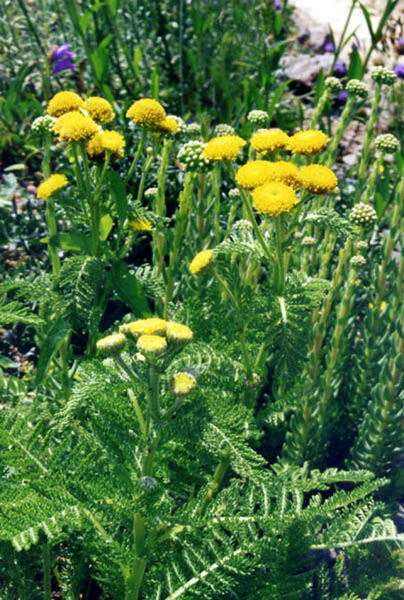
Perennial of the Asteraceae family, native to North America, where it is found around the Great Lakes, in the boreal regions of Canada and in some mountainous areas of the western continent. It naturally grows on sandy shores, open meadows, and well-exposed rocky slopes, often in acidic or neutral soil.
It forms upright clumps 30 to 50 cm in height, from a persistent base. The foliage is medium green, finely pinnate, with narrow and well-cut segments, aromatic when crushed, a characteristic shared with several tansies. The stems are upright and bear in corymbs bright and luminous buttercup-yellow flower heads, devoid of ligules, giving them that globular and dense appearance so characteristic of the genus.
In its natural habitat, its flowering extends from July to August. In cultivation, it occurs at similar dates and is generous and regular from year to year.
It is grown in full sun, in well-drained, ordinary to poor soil, and tolerates fairly dry conditions once established. Hardy and undemanding, it is suitable for large rock gardens, natural gardens, and sunny borders where its bright yellow contrasts effectively with the surrounding foliage.