(= Chrysanthemum haradjanii)
(= Chrysanthemum haradjanii)
Perennial of the Asteraceae family, native to Syria and southern Turkey, where it grows on arid rocky slopes and calcareous scree in the continental Mediterranean zone. It has been cultivated for several decades in European rock gardens, where its extraordinary foliage has caught the attention of collectors.
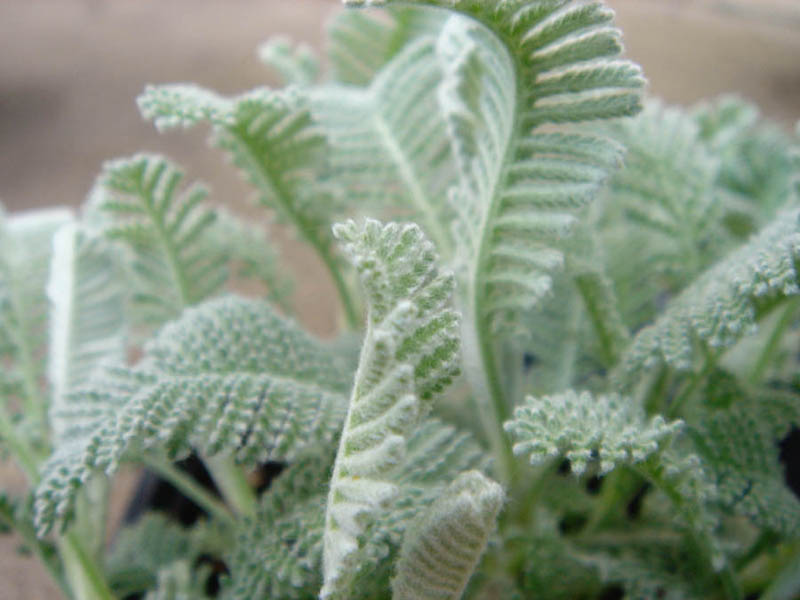
It forms a dense, spreading cushion, reaching 10 to 20 cm in height with a spread that can exceed 30 cm. It is primarily a foliage plant. The leaves, finely pinnatisect, are entirely covered with a dense tomentum of silvery white to very pale gray-green, giving them an almost unreal appearance. Their surface is remarkably embossed, with rounded and blistered segments, which gives the whole a sculptural texture quite unique in the world of rock garden plants.
The flowers are small yellow capitula, discreet, borne on short stems. In its natural habitat, its flowering extends from June to July. In cultivation, it occurs at comparable dates, but the interest of the plant lies almost entirely in its evergreen foliage throughout the season.
It requires very well-drained, poor soil, preferably calcareous or mineral, in full sun. It dreads stagnant moisture, particularly in winter, but gardeners in Atlantic climates report good resistance without special protection, provided the drainage is impeccable. It tolerates summer drought without difficulty.