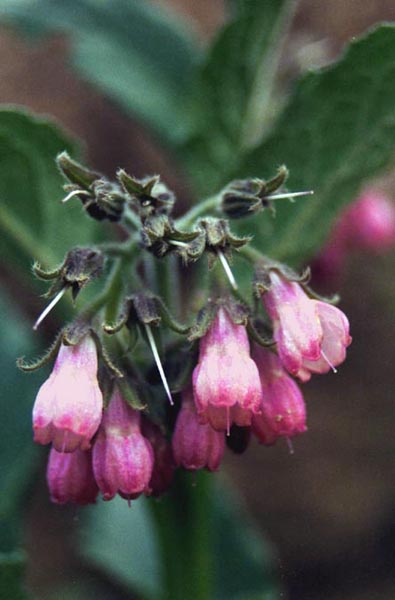
Perennial of the Boraginaceae family, a selected form of common comfrey, a species widely spread in Europe and Western Asia, from wet meadows and riverbanks to the edges and ditches of the lowland and submontane levels.
The plant forms upright clumps from 60 to 100 cm, with robust stems bearing lanceolate to oval-lanceolate leaves, large, medium green, covered with stiff hairs that give them a slightly rough texture. The cauline leaves are decurrent on the stem with well-marked wings, a distinctive feature of the species within the genus.
The flowers, gathered in drooping scorpioid cymes typical of the Boraginaceae, are tubular and a soft, bright pink, intermediate between white and true pink, softer than that of the 'Purpureum' cultivar. The arched cymes, laden with buds and open flowers simultaneously, give the inflorescence a graceful appearance that contrasts with the massive habit of the plant.
In its natural habitat, the species blooms from May to July. In cultivation, this cultivar follows roughly the same schedule.
Like the entire genus, this plant is very frequented by bumblebees, which abundantly forage there. The leaves rich in potassium are sometimes harvested for the preparation of fertilizing liquid manures.
It thrives in fresh to moist soil, rich in organic matter, in the sun or partial shade. Once established, its deep and fleshy roots make it practically immovable; therefore, the location must be chosen with care.