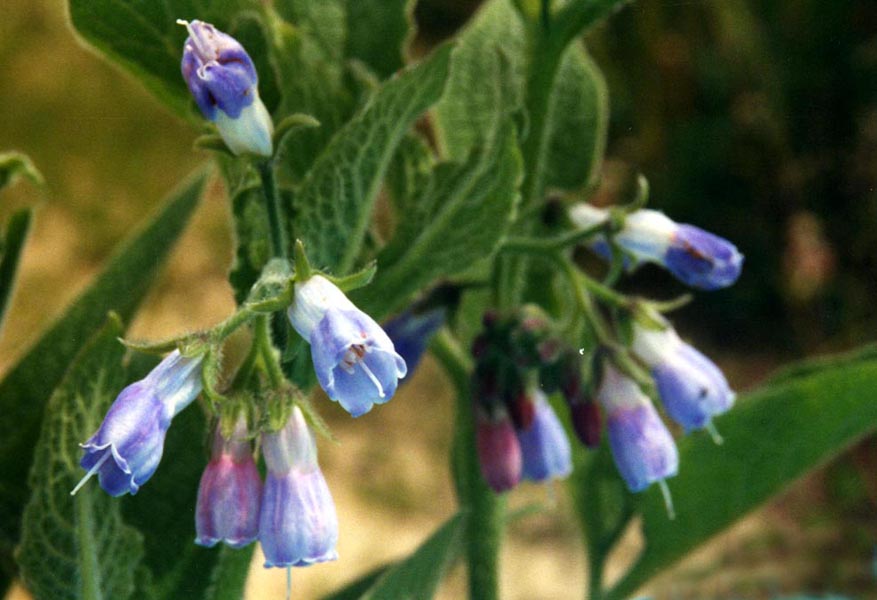
Perennial of the Boraginaceae family, native to the Caucasus, Anatolia, and Persia, naturalized in many regions of Western Europe after being introduced as a fodder plant in the 18th century. It naturally grows in wet meadows, roadsides, and edges, in plains as well as in moderate altitude.
It forms vigorous and upright clumps that can reach 80 to 120 cm, bearing large lanceolate to oval leaves, of medium green, covered with stiff and prickly hairs that give them a very rough texture to the touch — a characteristic directly evoked by the epithet asperum. The stems are also bristly.
The flowers, grouped in drooping scorpioid cymes, exhibit a remarkable and clearly visible color change as they develop: the buds are pink to red-purple, then the open corollas gradually turn lilac-blue to light blue, giving the inflorescence a characteristic bicolor appearance.
In its natural habitat, its flowering extends from May to July. In cultivation, it follows approximately the same calendar.
Like other comfreys, it is highly sought after by bumblebees. Its leaves have been used as green manure and fodder, which led to its introduction in Western Europe.
In cultivation, it accepts most fresh to moist soils, in full sun or partial shade. Hardy and undemanding, it can become invasive due to its deep roots, which are difficult to eliminate once established.