syn. Stipa tenuifolia
syn. Stipa tenuifolia
Perennial of the Poaceae family, native to Australia, where it naturally grows in dry meadows, rocky slopes, and well-exposed sandy soils. The name Stipa tenuifolia under which it is still very frequently marketed corresponds to a persistent horticultural use, but is taxonomically inaccurate.
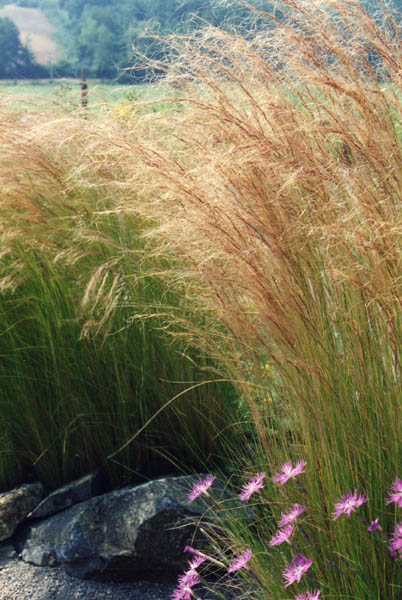
It forms dense and silky tufts 40 to 60 cm high, with very fine, almost hair-like leaves, a tender green in spring that gradually turns to golden beige to straw blonde in summer and autumn. The flowering spikes, light and feathery, rise above the foliage in an airy and undulating mass that reacts to the slightest breath of wind with remarkable fluidity. It is precisely this perpetual movement, this ability to make the wind visible, that constitutes the most striking feature of the plant.
In its natural habitat, its flowering extends from May to July. In cultivation, the inflorescences appear at the same time, then persist while gradually coloring until autumn, maintaining visual interest for several months.
The species is reported as potentially invasive in some regions with mild climates, notably in New Zealand; this point deserves attention before any planting in the Mediterranean region.
In cultivation, it requires well-drained soil, poor to moderately fertile, and a fully sunny exposure. It tolerates summer drought and withstands moderate cold. It is pruned at the end of winter to renew the foliage.