syn. Betonica officinalis
syn. Betonica officinalis
Perennial of the Lamiaceae family, this woundwort is widely spread in Europe, from the Iberian Peninsula to Western Asia. It frequents sparse meadows, woodland edges, calcareous grasslands, and grassy banks, from plains to the montane level, generally up to about 1,800 meters.
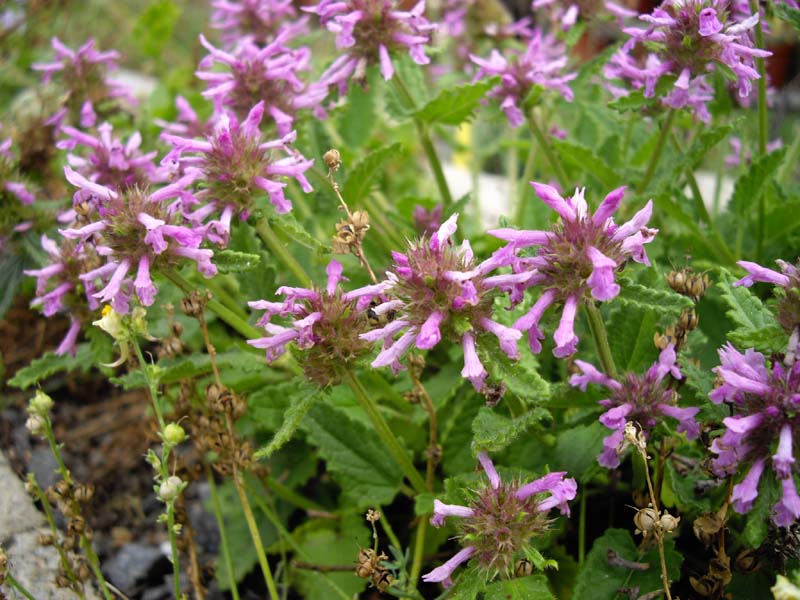
It forms a basal clump of oval to oblong leaves, crenate, slightly rough and pubescent, of a medium bright green. The flowering stems, sparsely leafy, rise to 20 to 40 cm, bearing dense terminal spikes of bilabiate flowers of a warm pink-purple, gathered in well-separated whorls that give the inflorescence its characteristic tiered appearance, very visible in the photograph.
In its natural habitat, its flowering extends from June to September. In cultivation, it generally blooms from July to August, sometimes earlier in warm and sunny conditions.
A nectariferous plant much appreciated by bumblebees and butterflies, it also has a long history of medicinal use in Europe, notably in English and Italian traditions, where its leaves were used in infusion for various ailments. It thrives in well-drained, moderately fertile soil, in sun or light partial shade, and readily naturalizes in meadow gardens or wild-style borders.