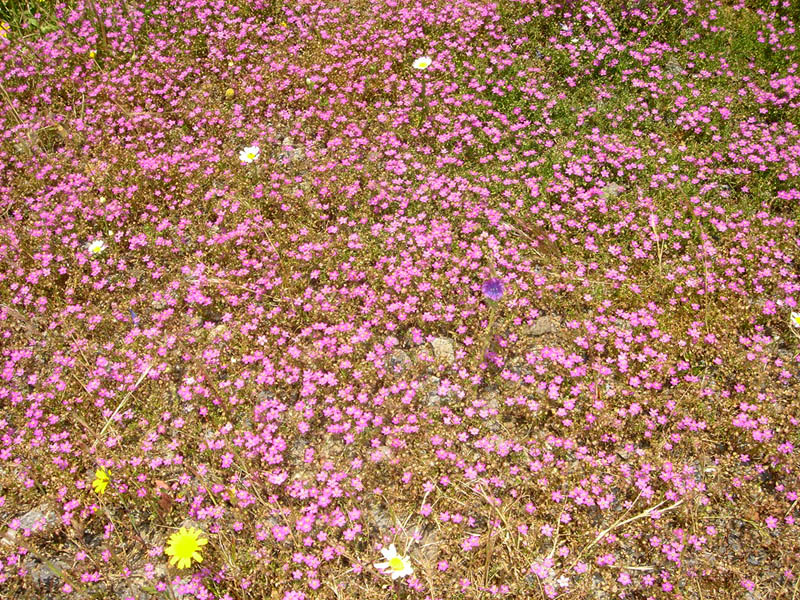
- photographed in Spain -
- photographed in Spain -
Perennial of the Caryophyllaceae family, the rock sandwort is a species of the Atlantic and Mediterranean coasts of Western Europe — Great Britain, Ireland, France, Spain, Portugal — strictly confined to maritime cliffs, coastal rocks, and granite or schist crevices exposed to wind and salty spray.
It forms low, dense, very branched tufts, reaching 5 to 10 cm in height, with sticky and glandular stems. The leaves are linear, fleshy, slightly glandular, grouped in bundles along the stems, characteristic of an adaptation to drought and salinity.
The flowers with five petals, bright pink to magenta pink, open abundantly above the foliage and cover the plant with a colorful carpet of great intensity. In its natural habitat, its flowering extends from May to September.
Its strict halophyte nature is its most distinctive trait; it tolerates salt concentrations inaccessible to the vast majority of rock garden plants. In cultivation, it requires very well-drained, poor soil, in full sun, and does not tolerate prolonged wet and cold winters under stagnant cover. It is suitable for cultivation in pots or troughs, in a very permeable sandy mix.