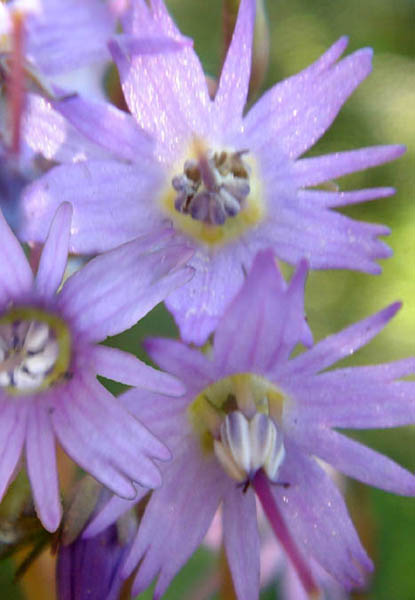
A perennial of the Primulaceae family, this soldanella is endemic to the Pyrenees, where it occupies a limited distribution area, mainly in the humid and shaded areas of the subalpine and alpine levels. It frequents cool grasslands, late snow patches, and stream edges, generally between 1,600 and 2,500 meters in altitude, on acidic, humus-rich substrates.
The plant forms small compact rosettes of rounded, leathery, and persistent leaves, with a glossy dark green, carried by thin petioles. The floral stems, slender and upright, generally do not exceed 10 to 15 cm. What immediately strikes, as shown in the photograph, is the widely spread corolla deeply cut into narrow strips of bright pinkish lilac, around a whitish to pale yellow center. This feature, quite different from the distinctly bell-shaped and hanging habit of other soldanellas, gives it an almost stellar appearance, almost unexpected in the genus.
In its natural habitat, its flowering extends from June to August depending on altitude and snow cover. In cultivation, it is known to be delicate, requiring a humus-rich soil, constantly cool to moist, slightly acidic, in a semi-shaded exposure, sheltered from summer heat and drying out. It is suitable for moist rock gardens, alpine troughs, and well-tended mountain gardens.
A rare species in cultivation, it primarily interests collectors of Pyrenean alpine plants. Its taxonomic status has sometimes been discussed, and some floras treat it as a variety or a form close to Soldanella villosa; however, the works of Vierhápper have restored it to the rank of a full species.
Botanists of the early 20th century considered it a jewel of the Dinaric mountains, where it coexists with other endemics like Edraianthus pumilio. Its name pays tribute to the Austrian botanist August von Degen, who contributed to the study of the Balkan flora.