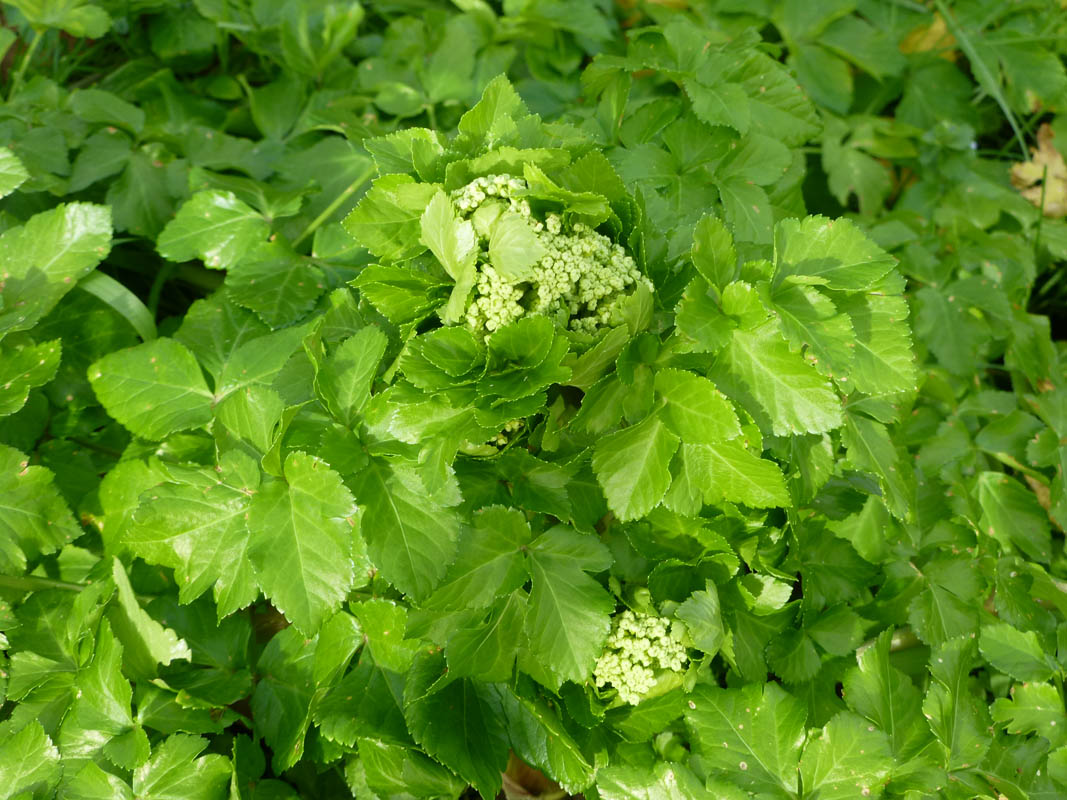
Biennial of the Apiaceae family, Alexanders is native to the Mediterranean basin and the Atlantic coasts of Western Europe, where it grows spontaneously on maritime cliffs, grassy embankments, rubble, and shaded edges, from sea level to modest altitudes.
It forms a robust plant, reaching 50 to 150 cm in bloom, with hollow and branched stems of a shiny green. The leaves are ternate to bi-ternate, with broad and glossy leaflets, of a characteristic dark green. The yellow-greenish flowers are gathered in compound umbels; the fruits blacken at maturity, giving the plant a bicolored appearance at the end of its cycle.
In its natural habitat, its flowering extends from March to May.
Its cycle is remarkably condensed for a biennial — vegetation is entirely concentrated during the cold period, from autumn to spring, before a long summer dormancy. Known as Macedonian parsley, it was cultivated as a vegetable plant since Antiquity; its young shoots, stems, leaves, roots, and seeds were consumed as a vegetable and aromatic condiment, before being gradually supplanted by celery. It appears in the Capitulare De Villis of Charlemagne, around 812, among the plants whose cultivation was ordered in the imperial domains.
It tolerates shade and heavy soils, and reseeds freely once established.